Electricians install, maintain and repair electrical power, communications, lighting and control systems in homes, businesses and factories (U.S. Bureau of Labor Statistics, 2026-08-27). The usual route in is a paid apprenticeship: most electricians learn the trade in a four- or five-year program combining on-the-job training with technical instruction (U.S. Bureau of Labor Statistics, 2026-08-27).
What you need on paper depends on where you work. Most U.S. states require electricians to pass a test and be licensed, and requirements vary by state (U.S. Bureau of Labor Statistics, 2026-08-27); in Canada, the Red Seal Occupational Standard for Construction Electrician is recognised nationally by the Canadian Council of Directors of Apprenticeship (Red Seal Program, 2026-01-05).
What This Role Actually Involves
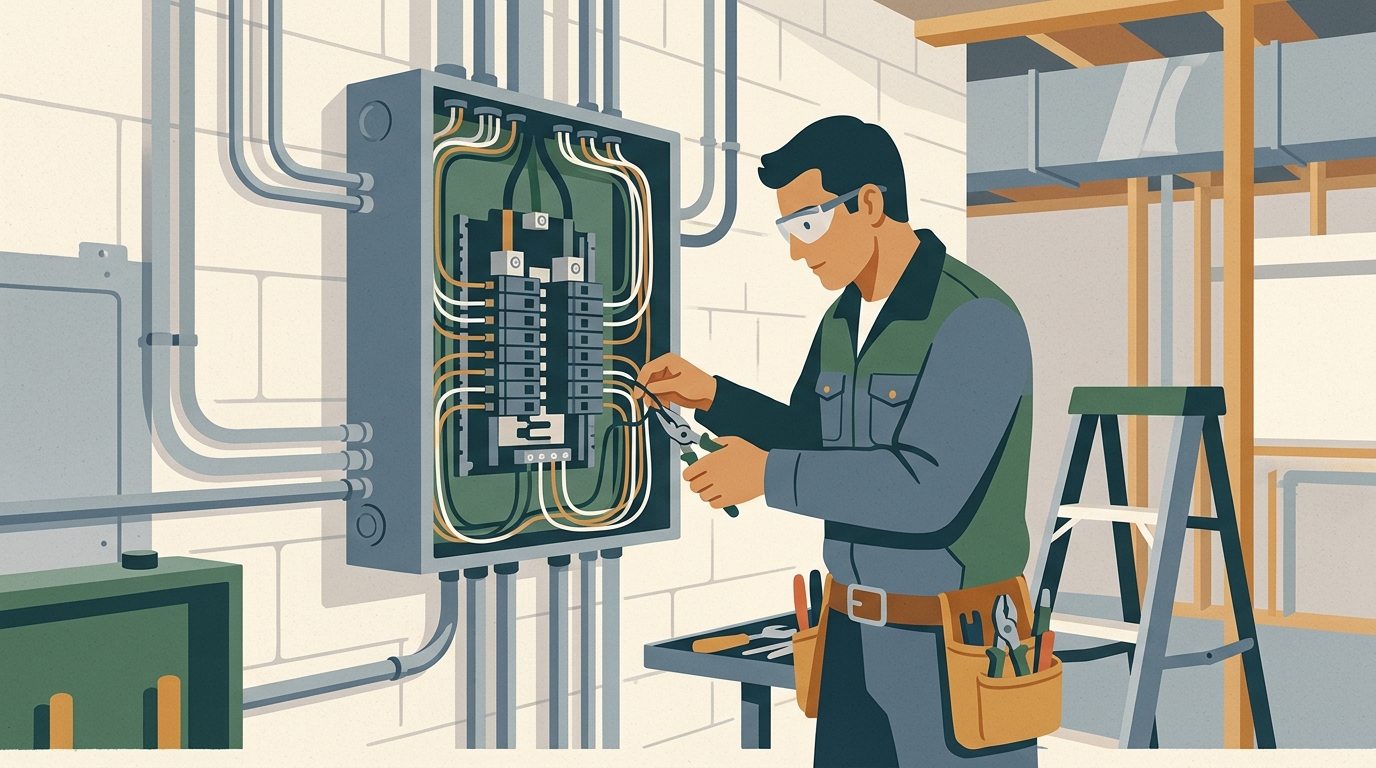
An electrician installs, maintains and repairs electrical power, communications, lighting and control systems in homes, businesses and factories (U.S. Bureau of Labor Statistics, 2026-08-27). The setting changes the work more than the job title does. Residential work leans towards rewiring, panel upgrades, fixture installation and fault-finding in occupied homes. Commercial and industrial work involves running conduit and cable tray, terminating larger feeders, wiring control panels and motors, and working to drawings on a construction schedule alongside other trades.
A typical day mixes planning and physical work: reading a drawing, confirming circuit layouts, isolating and proving dead, pulling and terminating cable, testing, then recording what was done. Fault-finding takes a different shape — questioning the occupant, narrowing the circuit, testing with a meter, then repairing or replacing.
Apprentices work under supervision. After completing an apprenticeship, electricians are considered journey workers and may perform duties on their own, subject to local or state licensing requirements, and may later advance to master electrician after meeting additional requirements and working as a qualified electrician (U.S. Bureau of Labor Statistics, 2026-08-27). Employers range from small contracting firms, where one person quotes, buys materials and does the work, to large contractors and in-house maintenance departments in factories, hospitals and utilities, where the role sits inside a maintenance or projects team.
Core Skills Breakdown
Technical skills
- Electrical theory applied to real circuits — calculating voltage drop on a long run to a workshop and choosing a larger conductor before the cable is pulled; theory forms part of apprentices' technical instruction (U.S. Bureau of Labor Statistics, 2026-08-27).
- Blueprint and schematic reading — taking a lighting layout and panel schedule from a drawing set and marking switch and socket positions on a bare stud wall (U.S. Bureau of Labor Statistics, 2026-08-27).
- Trade mathematics — working out conduit bend offsets so a run of pipe lands square on a junction box.
- Electrical code knowledge — checking that a bathroom circuit's protection and clearances meet the code edition the local authority has adopted, which differs between jurisdictions (U.S. Bureau of Labor Statistics, 2026-08-27).
- Safe isolation, testing and first aid — locking off a supply, proving dead, then verifying continuity, insulation resistance and polarity before energising, with the first-aid training apprenticeships include (U.S. Bureau of Labor Statistics, 2026-08-27).
- Fault diagnosis — tracing an intermittent trip to a damaged cable behind plasterboard rather than replacing the breaker and hoping.
Interpersonal skills
- Explaining work to non-electricians — telling a homeowner why their panel needs replacing, in words that let them decide.
- Coordinating with other trades — agreeing with the plumber and framer when first-fix wiring goes in, so walls are not closed before cables are run.
- Supervising apprentices — showing a first-year how to terminate a panel, then checking every connection before the cover goes on.
- Written record-keeping — completing test certificates and job sheets accurately enough for an inspector or the next electrician to follow.
Qualifications and Certifications
Requirements vary by country and, within the United States, by state. Confirm against the body that issues the credential where you intend to work.
| Qualification/Certification | Issuing Body | Country/Region | Typical Time to Complete |
|---|---|---|---|
| High school diploma or equivalent | State or provincial education authority or equivalency testing authority | United States and Canada | Prerequisite before apprenticeship (U.S. Bureau of Labor Statistics, 2026-08-27) |
| Electrician apprenticeship | Apprenticeship sponsors — contractors, unions or technical schools registered with the state apprenticeship authority | United States | 4 or 5 years (U.S. Bureau of Labor Statistics, 2026-08-27) |
| Journey worker / electrician licence | State electrician licensing board; most states require a test and licence and requirements vary, with state details listed by CareerOneStop (U.S. Bureau of Labor Statistics, 2026-08-27) | United States | After apprenticeship; varies by state |
| Red Seal endorsement, Construction Electrician | Red Seal Program; standard recognised by the Canadian Council of Directors of Apprenticeship (Red Seal Program, 2026-01-05) | Canada (national recognition) | After provincial or territorial apprenticeship, then the Red Seal exam |
| Master electrician licence | State or local licensing authority | United States | After journey worker experience and additional requirements (U.S. Bureau of Labor Statistics, 2026-08-27) |
| Specialty certifications — solar photovoltaic, electrical generating or lighting systems | The certifying organisation operating in your jurisdiction | Varies | Varies; held alongside a licence (U.S. Bureau of Labor Statistics, 2026-08-27) |
| Continuing education for renewal | State licensing board; covers safety, code changes and manufacturer product training (U.S. Bureau of Labor Statistics, 2026-08-27) | Varies by state | Ongoing, where required |
How to Build These Skills
- Finish secondary school or an equivalency. A high school diploma or equivalent is required to become an electrician (U.S. Bureau of Labor Statistics, 2026-08-27). Prioritise mathematics and any physics or electronics course available.
- Choose between an apprenticeship and a technical school start. Most electricians learn through an apprenticeship, but some start by attending a technical school (U.S. Bureau of Labor Statistics, 2026-08-27). A pre-apprenticeship course can strengthen an application; it does not replace the on-the-job hours.
- Apply to apprenticeship sponsors and sit their entry assessment. Sponsors typically test mathematics and reading and interview candidates. If you gained electrical experience in the military or in construction, ask whether you qualify for a shortened apprenticeship based on experience and testing (U.S. Bureau of Labor Statistics, 2026-08-27).
- Work the full apprenticeship term. Expect four or five years of paid on-the-job training plus technical instruction in electrical theory, blueprint reading, mathematics, code requirements and safety and first aid (U.S. Bureau of Labor Statistics, 2026-08-27). Keep a logbook of hours and systems worked on; licensing authorities commonly ask for it.
- Sit the licensing or certification exam after the required hours. In the United States, most states require a test and licence, with requirements varying by state and listed through CareerOneStop (U.S. Bureau of Labor Statistics, 2026-08-27). In Canada, review the Red Seal Trade Profile for self-assessment and the Exam Information page before booking (Red Seal Program, 2026-01-05).
- Work as a journey worker, then specialise and keep the licence current. Once licensed you may perform duties on your own, subject to local or state rules, and may add certifications in areas such as solar photovoltaic, electrical generating or lighting systems (U.S. Bureau of Labor Statistics, 2026-08-27). Continuing education may be required for renewal, and master electrician status follows further requirements and time as a qualified electrician (U.S. Bureau of Labor Statistics, 2026-08-27).
Skills Self-Check
Answer each honestly. A "no" is not a stop sign — it tells you what your apprenticeship or technical instruction needs to cover.
- I can read a floor plan and panel schedule and mark out where each circuit and device goes.
- I can calculate conductor size and voltage drop for a given load and run length without guessing.
- I can isolate a supply, lock it off and prove it dead before touching a conductor, every time.
- I can use a multimeter and insulation resistance tester and explain what the readings mean.
- I can look up a requirement in the code edition adopted where I work, rather than relying on how I was once shown.
- I can explain a fault and its repair to a customer with no electrical background.
- I am comfortable working at height, in confined roof spaces, and in heat, cold or dust for a full shift.
Frequently Asked Questions
Do I need a college degree to become an electrician?
No. A high school diploma or equivalent is required, and most electricians then learn through an apprenticeship, though some start at a technical school (U.S. Bureau of Labor Statistics, 2026-08-27). The occupation sits in Job Zone Three, medium preparation, where training usually comes from vocational schools, related on-the-job experience or an associate's degree (O*NET OnLine, U.S. Department of Labor).
How long does it take to qualify?
Most electricians learn their trade in a four- or five-year apprenticeship program, with paid on-the-job training and technical instruction in each year (U.S. Bureau of Labor Statistics, 2026-08-27). Workers who gained electrical experience in the military or in construction may qualify for a shortened apprenticeship based on their experience and testing (U.S. Bureau of Labor Statistics, 2026-08-27). Ask your sponsor what credit applies.
What does training cost?
Apprentices typically receive paid on-the-job training as well as some technical instruction for each year of the program (U.S. Bureau of Labor Statistics, 2026-08-27), so the site portion is earned rather than paid for. Classroom fees, tools, exam fees and licence applications vary by sponsor and jurisdiction. Ask the sponsor and the licensing board for current amounts in local currency.
Is a licence required everywhere?
Not uniformly. Most U.S. states require electricians to pass a test and be licensed, and requirements vary by state, with details available through CareerOneStop (U.S. Bureau of Labor Statistics, 2026-08-27). Some states regulate at city or county level instead. In Canada, provinces and territories certify the trade, and the Red Seal Occupational Standard is the national standard recognised by the Canadian Council of Directors of Apprenticeship (Red Seal Program, 2026-01-05).
What keeps a licence valid once I have it?
Electricians may be required to take continuing education courses to maintain their licences, usually covering safety practices, changes to the electrical code, and manufacturer training on specific products (U.S. Bureau of Labor Statistics, 2026-08-27). Whether this applies, how many hours count and how often renewal falls due depend on the state or provincial authority that issued your licence.
Sources
- U.S. Bureau of Labor Statistics — Electricians : Occupational Outlook Handbook (2026-08-27)
- O*NET OnLine (U.S. Department of Labor) — 47-2111.00 - Electricians