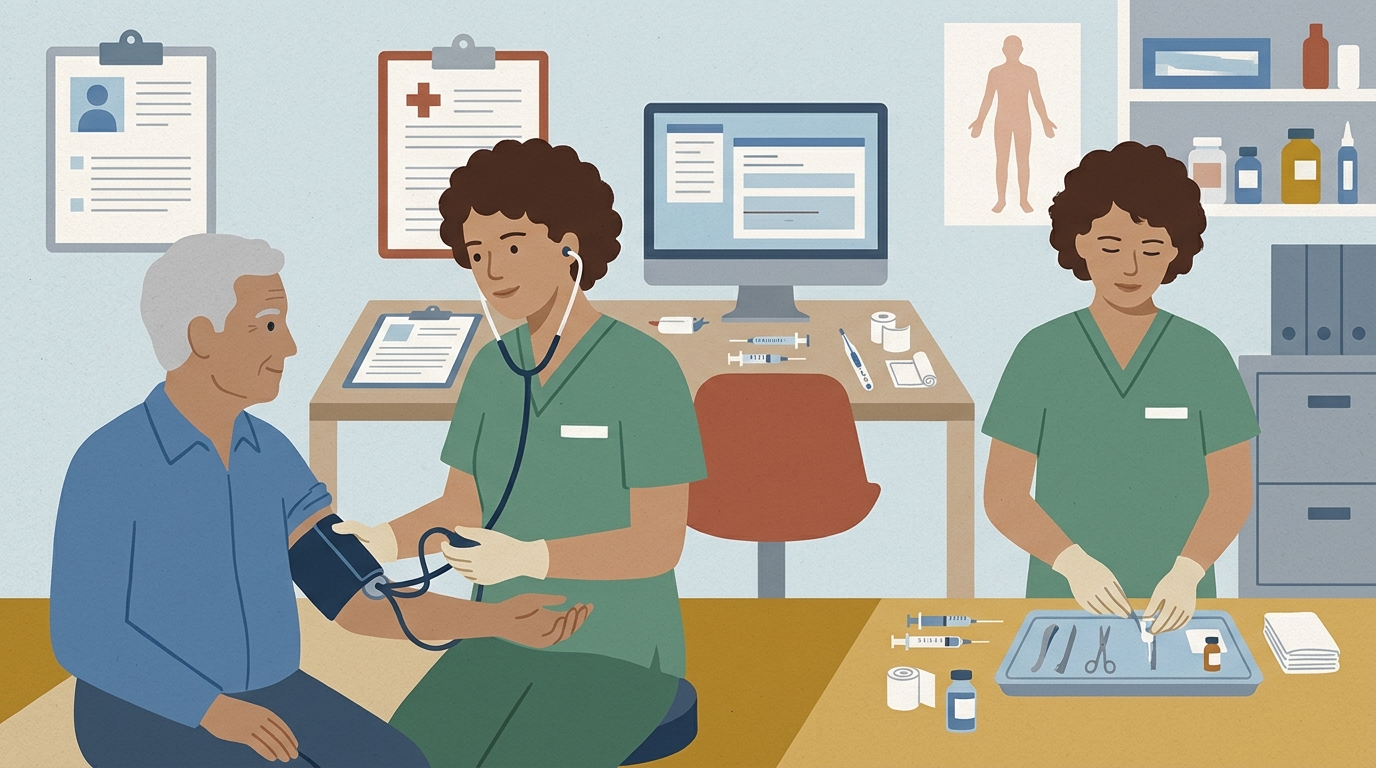
Medical assistants work both sides of a clinic: taking vital signs, preparing instruments and updating records, then scheduling, billing and answering patient questions at the desk. The skills are practical and teachable — clinical measurement, sterile technique, medical terminology, record-keeping and calm patient communication — and most people learn them in a short postsecondary programme rather than a degree.
What you need on paper depends on where you work. Some U.S. states require graduation from an accredited programme, licensure or certification before you can practise (U.S. Bureau of Labor Statistics, 2025), while other countries build the role around a multi-year diploma or treat it as a healthcare assistant job with employer-set requirements.
What This Role Actually Involves
A medical assistant splits the day between clinical and administrative work, usually in a physician's office, outpatient clinic or hospital department. Core tasks include interviewing patients to obtain medical information and measuring vital signs, weight and height; cleaning and sterilising instruments; and recording patients' medical history and test results (O*NET OnLine / U.S. Department of Labor, 2026). Depending on the employer and the rules where the clinic operates, that may extend to preparing treatment rooms, assisting during examinations or handling specimens.
The administrative half covers appointment scheduling, insurance or billing paperwork, routine phone enquiries and keeping the electronic health record accurate. In Canada, training programmes for the role cover business and medical communications, medical terminology, principles of health care operations, record-keeping and scheduling, policies and regulations, and professional standards and ethics (Wikipedia), which gives a fair picture of the paperwork load.
Organisationally, the medical assistant reports to a practice manager, office supervisor or lead nurse, and works under the direction of a physician or other licensed clinician. Scope of practice is set by the supervising clinician and by state, provincial or national rules, so this is not an independent role. The work is repetitive by design — the same rooming routine, the same intake questions, many times a day — and hours are often predictable clinic hours rather than nights and weekends.
Core Skills Breakdown
Technical skills
- Vital signs measurement — taking a manual blood pressure when an automated cuff reading looks implausible, and recording the retake with the time and position used.
- Instrument cleaning and sterilisation — running an autoclave cycle for suture removal kits, logging it and checking the indicator strip before the tray returns to use.
- Medical terminology — reading a note saying the patient presents with dyspnoea on exertion and entering the correct field without guessing.
- Electronic health record documentation — entering medications, allergies and today's results where the clinician will see them before walking into the room.
- Patient intake interviewing — working through a structured history with someone who answers out of order, capturing what is clinically relevant.
- Specimen handling — labelling a urine sample at the point of collection and bagging it for the laboratory courier within the required window.
Interpersonal skills
- Explaining instructions — telling a patient how to fast before a blood test and checking they can repeat it back.
- Composure under pressure — continuing to room patients calmly while someone in the waiting area is angry about a delay.
- Confidentiality in a shared space — confirming a patient's details at the desk quietly enough that the queue behind cannot hear.
Qualifications and Certifications
Requirements vary by country and, within the United States, by state — some states require graduation from an accredited programme, licensure or certification in order to practise, and employers may require Basic Life Support (BLS) certification (U.S. Bureau of Labor Statistics, 2025). Check the rules where you intend to work before enrolling anywhere.
| Qualification/Certification | Issuing Body | Country/Region | Typical Time to Complete |
|---|---|---|---|
| Medical assisting certificate or diploma | Programmes accredited by the Commission on Accreditation of Allied Health Education Programs (CAAHEP) or the Accrediting Bureau of Health Education Schools (ABHES) | United States | About 12 months; accredited programmes typically run nine to 12 months with an externship (Concorde Career Colleges, 2024) |
| Associate degree in medical assisting | CAAHEP- or ABHES-accredited colleges | United States | About two years (Concorde Career Colleges, 2024) |
| CMA (AAMA) certification | American Association of Medical Assistants (AAMA) | United States | Exam taken on or near graduation from a CAAHEP- or ABHES-accredited programme (Goodwin University) |
| RMA certification | American Medical Technologists (AMT) | United States | After accredited programme completion (Wikipedia) |
| Clinical or administrative medical assistant certification | National Healthcareer Association (NHA), which writes and publishes these allied health exams (Wikipedia) | United States | After accredited programme completion |
| Medical assistant programme (communications, terminology, records, ethics) | Colleges overseen by each province's ministry responsible for post-secondary education | Canada | Varies by college — confirm with the institution |
| Diploma in Medical Assistant (DMA), for Assistant Medical Officers | Programme recognised by the Malaysian Qualifications Agency | Malaysia | Three and a half years (Wikipedia) |
In the United Kingdom the nearest titles are 'clinical assistant' or 'healthcare assistant' (Wikipedia), and entry expectations are set by the employing organisation rather than a single national medical assisting exam.
How to Build These Skills
- Confirm the rules for your jurisdiction first. Some U.S. states require accredited-programme graduation, licensure or certification before you can practise, and employers may require BLS certification (U.S. Bureau of Labor Statistics, 2025). Outside the U.S., check the national route — Malaysia's Assistant Medical Officer path is a three-and-a-half-year diploma recognised by the Malaysian Qualifications Agency (Wikipedia).
- Enrol in an accredited programme. In the United States, choose one accredited by CAAHEP or ABHES, because that accreditation is a requirement of certifying agencies including the AAMA, American Medical Technologists and the National Healthcareer Association (Wikipedia).
- Complete the coursework before the placement. Terminology, anatomy, infection control and documentation come first; accredited programmes typically run nine to 12 months and include an externship (Concorde Career Colleges, 2024).
- Use the externship as evidence. Track patient intakes, vital sign sets and autoclave cycles completed, and ask your preceptor for written feedback you can cite in applications.
- Add BLS certification if your state or employer expects it (U.S. Bureau of Labor Statistics, 2025), and confirm which provider's card the employer accepts.
- Sit the certification exam once eligible. The CMA (AAMA) standard pathway requires that you have graduated, or are about to graduate, from a CAAHEP- or ABHES-accredited programme (Goodwin University); there are five eligibility categories in total (MedPreps, 2026).
- Apply to clinic roles and keep your records together. The nonrecent-graduate route requires an official transcript to verify eligibility (Mometrix), so request yours early.
Skills Self-Check
Answer yes or no, honestly, before you commit to a programme.
- I can take and record a manual blood pressure, pulse, temperature, height and weight without being prompted through the steps.
- I can read a clinical note containing standard medical abbreviations and enter the information in the right record field.
- I can run and log a sterilisation cycle and spot an indicator that has failed.
- I can ask a structured set of history questions and keep the conversation on track when a patient digresses.
- I can repeat the same rooming and documentation routine dozens of times a day and keep the last one as accurate as the first.
- I can explain a preparation instruction, such as fasting before a test, and confirm the patient understood it.
- I can name the accreditation and certification rules that apply in the state, province or country where I plan to work.
Frequently Asked Questions
How long does medical assistant training take?
A certificate or diploma route takes roughly 12 months and an associate degree about two years; accredited medical assisting programmes typically run nine to 12 months and include an externship (Concorde Career Colleges, 2024). Elsewhere it is longer — Malaysia's Diploma in Medical Assistant, recognised by the Malaysian Qualifications Agency, is a three-and-a-half-year undergraduate programme (Wikipedia).
Do I have to be certified to work as a medical assistant?
Not everywhere. Some states require medical assistants to graduate from an accredited programme, be licensed or certified, or meet other prerequisites in order to practise, and employers may require Basic Life Support certification (U.S. Bureau of Labor Statistics, 2025). Other jurisdictions set no single national exam at all. Check your state board, provincial ministry or national health authority before enrolling.
What does it cost to qualify?
Tuition and exam fees are set by individual colleges and certifying bodies, in local currency, and change regularly. The CMA (AAMA) listing on Army Credentialing Opportunities On-Line notes a fee alongside the eligibility and written exam requirements (U.S. Army COOL). Request the current fee schedule from the AAMA, AMT or NHA, plus published tuition from each programme you shortlist.
Is the job the same in other countries?
The tasks overlap but titles and training differ. In Canada, programmes cover business and medical communications, terminology, health care operations, record-keeping, scheduling, regulations and professional ethics (Wikipedia). In the United Kingdom the comparable roles are 'clinical assistant' or 'healthcare assistant' (Wikipedia), where the employer sets entry expectations rather than a national certification exam.
Sources
- U.S. Bureau of Labor Statistics — Medical Assistants : Occupational Outlook Handbook (2025)
- O*NET OnLine / U.S. Department of Labor — 31-9092.00 - Medical Assistants (2026)