Forklift operating mixes machine handling, load judgement and safety discipline. You need to control a counterbalanced truck in tight spaces, read a load chart and capacity plate, carry out pre-use inspections, and work safely around pedestrians and racking.
The formal side varies by country. In the UK, training is delivered by instructors accredited by bodies such as RTITB, ITSSAR, AITT or NPORS under Health and Safety Executive guidance; in Australian states and territories you need a high risk work licence from the state WHS regulator; in the United States, OSHA places the duty to train and certify on the employer.
What This Role Actually Involves
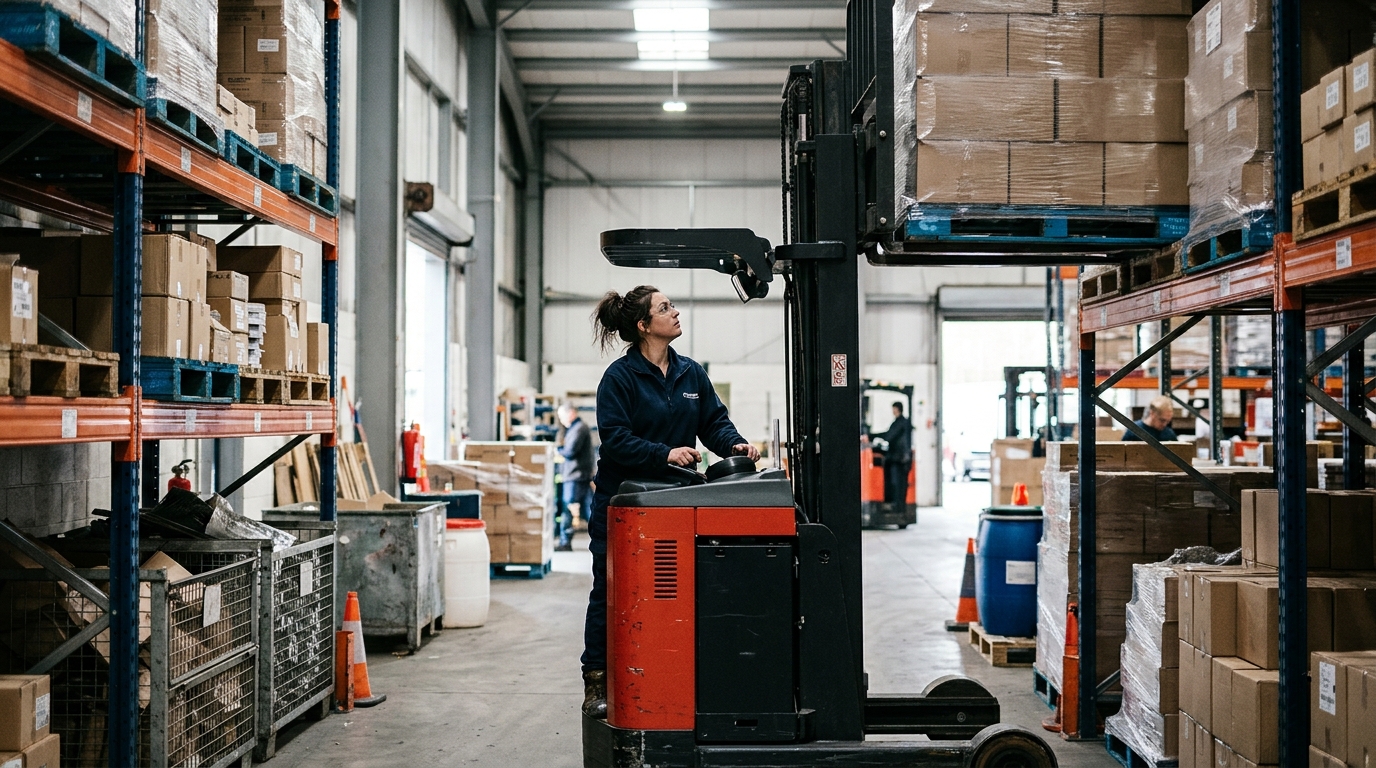
A forklift operator moves palletised and loose goods between delivery vehicles, racking, production lines and despatch areas. A shift usually starts with a pre-use inspection: forks, chains, hydraulics, tyres, horn, lights, brakes and fuel or battery charge, with any defect logged so a damaged truck is taken out of service rather than driven.
Most of the day is loading and unloading trailers or containers, putting stock away into racking at height, picking pallets for despatch and feeding materials to production. Each move involves checking the weight and dimensions of the load against the truck's capacity plate, positioning the forks, travelling with the load low and tilted back, and approaching racking squarely. Around the driving there is system work: scanning barcodes on a handheld terminal, confirming locations in a warehouse management system and flagging damaged or mislabelled stock.
Operators normally report to a warehouse or shift supervisor and work alongside pickers, loaders, goods-in clerks and drivers. Some stay on one site; others move between construction sites, builders' merchants, ports, cold stores or farms, where truck types and hazards differ. Hours are often shift-based, including nights and weekends, and the work is physical and noisy, with long periods of concentration.
Core Skills Breakdown
Technical skills
- Load assessment: using the capacity plate and load chart to work out whether a pallet can still be lifted safely once the load centre moves forward or the mast is raised.
- Pre-use inspection: spotting a hydraulic leak under the mast or a worn fork heel during the daily check and tagging the truck out before it is used.
- Mast and fork control: destacking a pallet from the third beam level without clipping the beam or shifting loads above it.
- Manoeuvring in confined space: reversing out of a container or along a narrow aisle using mirrors, horn and clear sight lines.
- Truck-specific handling: adjusting technique between a counterbalance, reach truck, telehandler and order picker, which differ in stability and visibility.
- Systems and documentation: scanning a pallet into a putaway location and recording a short-shipped delivery on the goods-in paperwork.
Interpersonal skills
- Pedestrian awareness: stopping and making eye contact with a picker stepping out of an aisle rather than assuming they have seen the truck.
- Shift handover: telling the next operator that a trailer is half-loaded and which bay the remaining pallets are in.
- Refusing unsafe work: declining to lift an overweight or badly wrapped load and explaining to the supervisor why it needs re-palletising.
- Working with drivers: agreeing with a lorry driver that keys are held and the trailer restrained before loading begins.
Qualifications and Certifications
Requirements differ sharply between countries, and in federal systems between states and provinces. Check current rules with the named body before booking anything.
| Qualification/Certification | Issuing Body | Country/Region | Typical Time to Complete |
|---|---|---|---|
| Accredited counterbalance operator training (novice) | Instructors accredited by RTITB, ITSSAR, AITT or NPORS, under Health and Safety Executive guidance (ACOP L117) | United Kingdom | Commonly several consecutive days for a novice; shorter for refresher or conversion |
| Licence to operate a forklift truck (TLILIC0003) | State/territory WHS regulator (for example SafeWork NSW, WorkSafe Victoria), trained and assessed by an RTO registered with ASQA | Australia | A few days of training and assessment, plus a licence application to the regulator |
| Employer certification under 29 CFR 1910.178(l) | The employer, to the standard set by OSHA or an OSHA-approved State Plan | United States | Formal instruction plus a practical evaluation; re-evaluation at least every three years |
| Operator training referencing CSA B335 | Employer or training provider, under the provincial OHS regulator (for example WorkSafeBC) | Canada | Typically one to two days, plus site-specific familiarisation |
| Construction Skills Certification Scheme card, counterbalance forklift | SOLAS | Ireland | Training plus a skills test, commonly around a week for a beginner |
No single card is valid everywhere: a UK accredited certificate does not substitute for an Australian high risk work licence, and a US employer certification is tied to that employer and truck type.
How to Build These Skills
- Check the entry rules where you live. Minimum age, eyesight requirements and whether a road driving licence is needed vary — confirm with HSE in Great Britain, your state WHS regulator in Australia, OSHA or an approved State Plan in the US, or your provincial OHS authority in Canada.
- Get into a warehouse first. A few months as a picker, loader or goods-in assistant teaches racking layouts, pallet types, scanning systems and site traffic rules before you are responsible for a truck.
- Book a novice course with an accredited provider for the truck type you want; counterbalance is the usual starting point. In the UK that means an instructor accredited by RTITB, ITSSAR, AITT or NPORS; in Australia, an ASQA-registered RTO delivering TLILIC0003.
- Pass the theory and practical assessment: written questions on stability, capacity and legislation, plus an observed practical covering inspection, stacking, destacking and loading.
- Apply for the licence or card where the jurisdiction issues one. In Australia you apply to your state or territory regulator after assessment, within the period it sets. In the UK and US there is no state licence; your certificate or employer certification is the record.
- Complete site and truck familiarisation with the employer, covering aisle widths, pedestrian routes and racking limits, then keep training current. OSHA requires operator re-evaluation at least every three years; UK practice commonly uses refresher training on a similar cycle, with conversion courses adding truck categories.
Skills Self-Check
Answer each honestly — a string of "no" answers points to what to train next, not to a dead end.
- I can find the capacity plate on a truck and explain how load centre affects what it can lift.
- I can carry out and record a pre-use inspection and say which defects mean the truck must not be used.
- I can judge whether a pallet is stable and correctly wrapped before I lift it.
- I am comfortable reversing and manoeuvring with limited visibility, using mirrors and the horn.
- I can place and retrieve a pallet at height without disturbing adjacent loads.
- I can use a handheld scanner or warehouse system to confirm stock locations and flag discrepancies.
- I will stop work and raise a concern with a supervisor when a load or route is unsafe, even under time pressure.
Frequently Asked Questions
How old do I have to be to operate a forklift?
It depends on the jurisdiction. In Australia, high risk work licences issued by state and territory WHS regulators are available from age 18. In Great Britain, HSE guidance sets no single statutory age for site operation, but employers and insurers usually set their own minimum. In the United States, OSHA sets 18 for most powered industrial truck work in non-agricultural settings.
How long does it take to get certified?
A novice counterbalance course typically runs over several consecutive days, combining theory, practical operation and assessment. Refresher and conversion courses for experienced operators are shorter, often one or two days. Where a government licence is issued, such as Australia's high risk work licence, add processing time for the application to your state or territory regulator after assessment.
What does forklift training cost?
Fees are set by individual training providers, not by a national price list, so they vary widely by country, truck type and course length. Budget separately for the course, any assessment fee, and — in jurisdictions such as Australia — a licence application fee paid to the regulator in local currency. Many employers fund training for staff; ask providers for current figures.
Does my certificate work for any employer?
Not automatically. In the United States, OSHA ties certification to the employer, the truck type and the workplace, so a new employer must evaluate you again. In the UK, an accredited certificate is portable but employers must still provide job-specific and site-specific familiarisation. Licences issued by Australian state regulators are generally recognised across states, subject to each regulator's rules.
Do I need a car or road driving licence?
For operating on private sites, usually not — site operation is governed by workplace safety law rather than road traffic law. If you need to drive a forklift on a public road, separate rules apply: in New Zealand, for example, Waka Kotahi NZ Transport Agency requires an F endorsement on your driver licence. Check your national road authority before driving off-site.