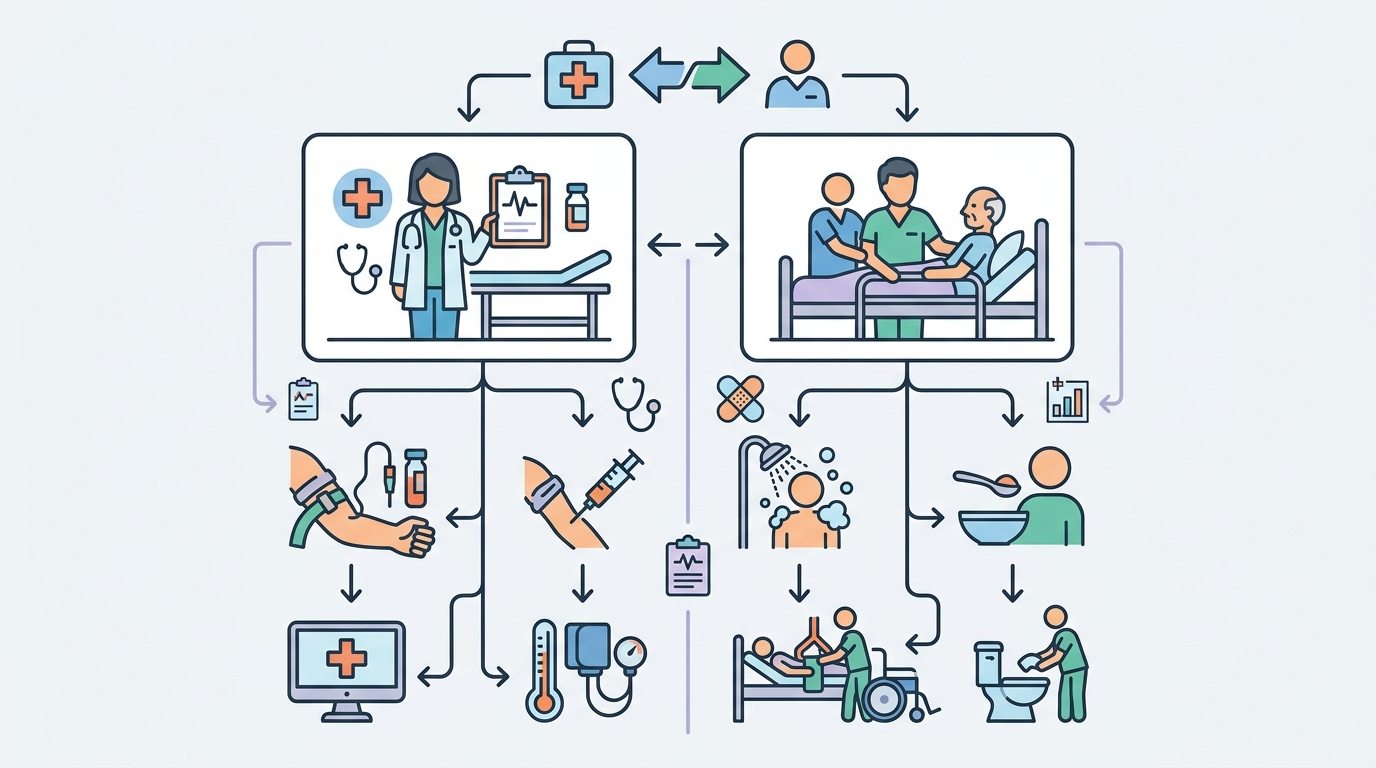
Medical assistants and certified nursing assistants both work directly with patients, but they train under different rules and answer to different bodies. CNA training in the United States has a federal floor of 75 clock hours, at least 16 of them supervised practical training (Learnsignal, undated, citing 42 CFR §483.152), while the CMA (AAMA) credential is open only to people who completed a CAAHEP- or ABHES-accredited medical assisting program or who fit one of the association's other named eligibility categories (MedPreps, 2026-09-02).
Both titles are American and tied to American credentials. Elsewhere, comparable jobs exist as healthcare assistant, nursing auxiliary or clinic assistant and are governed by your own country's health ministry or nursing regulator, so check that body's rules rather than assuming the US structure applies.
Side-by-Side Skills Comparison
| Category | Medical Assistant | CNA (certified nursing assistant) |
|---|---|---|
| Typical setting | Physician offices and outpatient clinics, moving between the front desk and the exam room | Nursing homes, long-term care, hospitals and home care, working an assignment under an RN or LPN |
| Core clinical tasks | Rooming patients, vital signs, instrument set-up, assisting at minor procedures, and — where state rules allow — injections and specimen collection | Bathing, dressing, toileting and feeding, safe transfers and repositioning, recording intake and output, reporting changes to the nurse |
| Personal-care skills | Not a core requirement in most clinic roles | Central: the federal standard requires supervised practical training in direct resident care (American Health Care Association / National Center for Assisted Living, undated) |
| Administrative skills | Commonly expected — booking follow-ups, updating the electronic health record, referrals, insurance paperwork | Not required; documentation is clinical, such as charting a meal percentage or a skin observation |
| Minimum training | Varies by school; the CMA (AAMA) route requires a CAAHEP- or ABHES-accredited program (MAExamPrep, undated) | At least 75 clock hours including at least 16 supervised practical hours (Learnsignal, undated, citing 42 CFR §483.152) |
| Who sets the standard | Certifying bodies: AAMA for the CMA, NHA for the CCMA, AMT for the RMA (MedReport Foundation, undated) | Federal law sets the floor; each state sets the approved program list, extra hours and exam vendor (NursingLicensure.org, undated) |
| Certification exam | CMA (AAMA): 200 questions, 180 scored and 20 unscored, in four 40-minute segments, administered by the AAMA (MedReport Foundation, undated) | State competency evaluation with written and skills components, vendor chosen by the state (NursingLicensure.org, undated) |
| Is certification compulsory? | Varies by state and employer; check your state medical board's rules before agreeing to duties such as injections | Certification and nurse aide registry listing are the standard route into nursing-home work; confirm with your state registry |
Where the Gaps Are
The gaps are procedural, not attitudinal.
Coming from the CNA side, the obstacle is eligibility. The CMA (AAMA) exam has five eligibility categories as of October 2026: completing student or recent graduate of a CAAHEP- or ABHES-accredited program, nonrecent graduate of an accredited program, CMA recertificant, Alternative Pathway graduate, and qualifying educator (MedPreps, 2026-09-02). The educator route needs at least 1,000 hours as a medical assisting educator (CertSQill, undated). There is no work-experience pathway and no military-experience pathway, and a candidate whose school is not CAAHEP- or ABHES-accredited cannot sit the exam regardless of years worked (MAExamPrep, undated). The association grants no exceptions to those requirements (AAMA Legal Eye, 2010-08-09). The CCMA issued by NHA and the RMA issued by AMT have different eligibility rules (MedReport Foundation, undated), so a door closed for one credential may not be closed for all.
Coming from the medical assistant side, the gap is the nurse aide program itself. Federal law requires no fewer than 75 clock hours, at least 16 of them practical training directly overseen by an LPN or RN (McKnight's Long-Term Care News, undated). Clinic experience with vital signs does not substitute for the daily-living skills tested at the competency evaluation: a two-person transfer, perineal care, or measuring and recording output. States also differ on hours above the federal minimum and on the exam vendor (NursingLicensure.org, undated).
Closing the Gap
These steps assume you hold a CNA certification and want to work as a certified medical assistant. Keep them in order — the certifying body treats program completion as a prerequisite, not something you can backfill.
- Pick the destination credential first. The CMA (AAMA), the CCMA issued by NHA and the RMA issued by AMT are different exams with different eligibility rules (MedReport Foundation, undated). All four major medical assistant credentials discussed are NCCA-accredited, but the CMA (AAMA) is restricted to graduates of CAAHEP- or ABHES-accredited programs (MAExamPrep, undated).
- If you are aiming for the CMA (AAMA), confirm with CAAHEP or ABHES that the specific campus and program are accredited before you enrol or pay anything; your CNA hours will not rescue an application from a non-accredited school (MAExamPrep, undated).
- Complete the program, including its practicum. This is where you pick up what a CNA post does not cover — electronic health record documentation, scheduling and referrals, instrument set-up, and any injection or specimen work your state permits.
- Apply within 12 months of completing the program to qualify under Category 1 (Open Exam Prep, 2026-07-21). Miss that window and you apply as a nonrecent graduate under Category 2, with an exam fee listed at $125 for members or $250 for nonmembers (Open Exam Prep, 2026-07-21); treat fees as approximate and confirm them with the American Association of Medical Assistants.
- Sit the exam — 200 questions, 180 scored and 20 unscored, in four 40-minute segments (MedReport Foundation, undated) — and keep your CNA certification active on your state nurse aide registry meanwhile, checking your state medical board's scope-of-practice rules before accepting new clinical duties.
Qualification Equivalents
| Medical Assistant Credential | CNA Equivalent | Gap or Extra Requirement |
|---|---|---|
| CMA (AAMA), issued by the American Association of Medical Assistants | No direct equivalent — CNA status is a state registry listing, not a national certification | Apply through your state nurse aide registry; each state sets the approved program list and exam vendor (NursingLicensure.org, undated) |
| Completion of a CAAHEP- or ABHES-accredited medical assisting program | State-approved nurse aide training and competency evaluation program | At least 75 clock hours, 16 of them supervised practical (Learnsignal, undated, citing 42 CFR §483.152); an accredited MA program does not automatically substitute — ask your state registry |
| CMA (AAMA) exam, four 40-minute segments (MedReport Foundation, undated) | State competency evaluation, written plus skills | Different format and vendor by state; passing one earns no credit toward the other |
| CCMA (NHA) or RMA (AMT) | No direct equivalent | Eligibility differs from the CMA (AAMA) (MedReport Foundation, undated); check each body's rules |
| Medical assisting externship hours | 16 hours of practical training overseen by an LPN or RN (McKnight's Long-Term Care News, undated) | The supervision rule is specific to nurse aide training; clinic externship hours are not interchangeable |
| Years of paid work as a CNA | Counts toward CNA recertification as your state defines it | No direct equivalent for the CMA (AAMA): no work-experience pathway and no exceptions (MAExamPrep, undated; AAMA Legal Eye, 2010-08-09) |
| Front-office and EHR training | Not required for CNA practice | Build it only if you plan to move into medical assistant work |
Frequently Asked Questions
I have worked as a CNA for years. Can that experience replace a medical assisting program?
Not for the CMA (AAMA). There is no work-experience pathway and no military-experience pathway, and a candidate from a school that is not CAAHEP- or ABHES-accredited cannot sit the exam regardless of years worked (MAExamPrep, undated). The association grants no exceptions to its eligibility requirements (AAMA Legal Eye, 2010-08-09). Other medical assistant credentials set their own rules.
I am a medical assistant. How do I become a CNA?
Through a state-approved nurse aide training and competency evaluation program. Federal law requires no fewer than 75 clock hours, at least 16 of them supervised practical training (Learnsignal, undated, citing 42 CFR §483.152). Each state sets its own approved program list, any hours above that floor, and the exam vendor (NursingLicensure.org, undated), so start with your state's nurse aide registry.
These credentials are American. What applies outside the United States?
The CNA training floor comes from United States federal regulation and the CMA (AAMA) is issued by an American association, so neither travels automatically. Elsewhere, similar bedside and clinic roles are regulated nationally or regionally under different titles. Check your country's health ministry or nursing regulator for the recognised qualification and whether registration is compulsory before you train.
Sources
- McKnight's Long-Term Care News — CMS promises remote training, waiver flexibilities for nurse aide certification
- Learnsignal — How to Become a Certified Nursing Assistant (CNA) in the US