
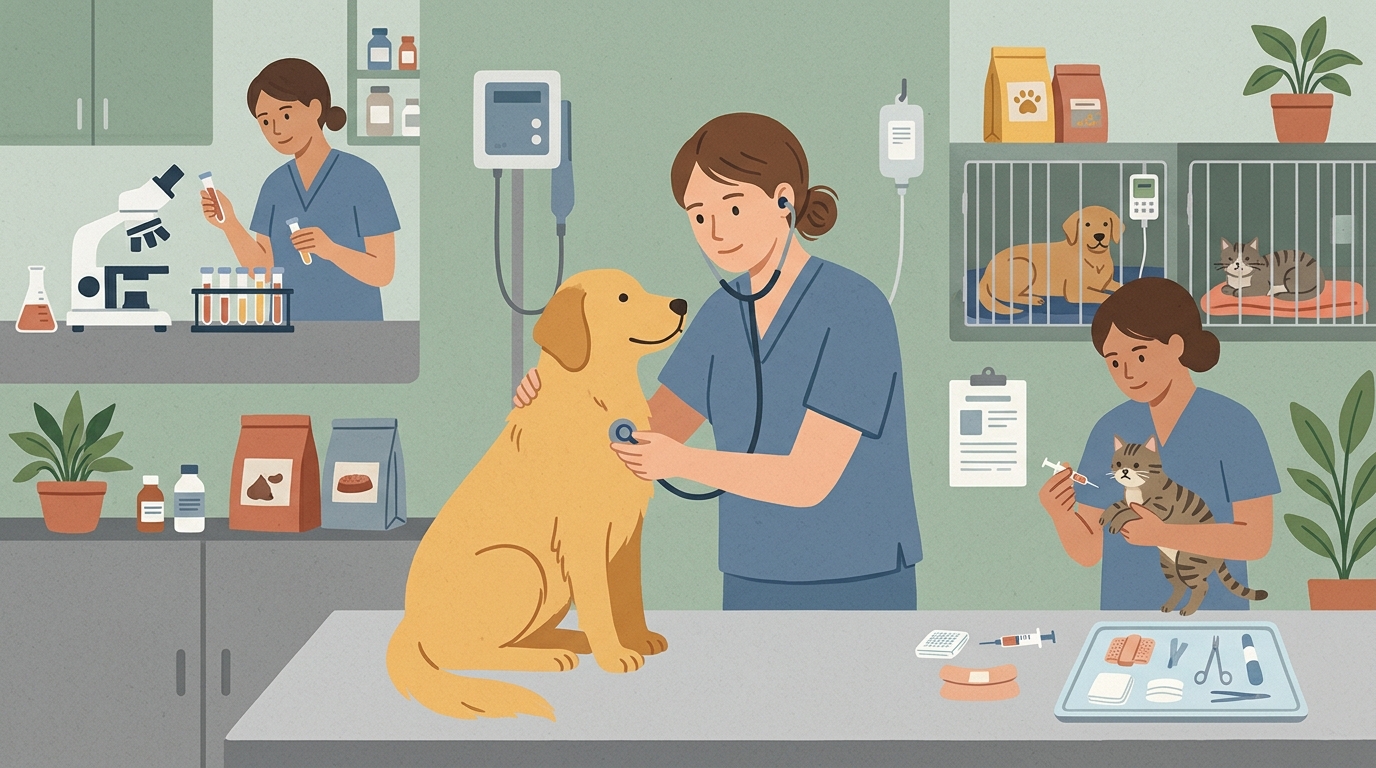
A veterinary technician is the credentialed nurse of the animal clinic: you restrain patients for exams, induce and monitor anesthesia, run blood counts and urinalyses, take x-rays, give medications and vaccines, and keep the case record straight (U.S. Bureau of Labor Statistics, 2025). In the United States the usual entry qualification is a two-year associate's degree from an accredited veterinary technology program, followed by a credentialing exam and a state credential (U.S. Bureau of Labor Statistics, 2025).
The title and the licensing body change with the country — Registered Veterinary Technician in Canada, Registered Veterinary Nurse in the UK — so check the rules of the jurisdiction you intend to work in before you enrol anywhere.
A Day in the Life
Most shifts start before the first appointment. You check the treatment board, read overnight notes on inpatients, and do rounds: temperature, pulse, respiration, mucous membranes, pain score, appetite, whether the post-op dog has urinated. Observing animal behavior and condition and recording case histories are core duties of the job, not afterthoughts (U.S. Bureau of Labor Statistics, 2025).
Then the day splits into three streams that run at once.
Outpatients. You restrain animals during exams — a cat burrito in a towel, a nervous retriever held in a standing lateral so the veterinarian can palpate an abdomen. You administer medications and vaccines, bathe animals and clip nails, and give nursing care or emergency first aid when a walk-in arrives panting and collapsed (U.S. Bureau of Labor Statistics, 2025). Between patients you enter charges and notes in practice management software; AVImark is one of the systems reported for this occupation (O*NET OnLine, U.S. Department of Labor, 2026).
Surgery. You prepare animals and instruments for surgery: clip and scrub the site, place an IV catheter, lay out a pack, confirm the endotracheal tube size. You administer anesthesia and monitor the patient's responses through the procedure — capnograph, pulse oximeter, blood pressure, eye position, jaw tone — adjusting the vaporizer and telling the surgeon when something changes (U.S. Bureau of Labor Statistics, 2025). After extubation you stay with the patient until it lifts its head.
Lab and imaging. You take x-rays, positioning a painful hip without a second sedation if you can, and perform laboratory tests such as urinalyses and blood counts (U.S. Bureau of Labor Statistics, 2025). Sediment under the microscope, a packed cell volume spun in the centrifuge, a fecal float set up while you eat standing in the treatment room.
Work happens in private clinics, animal hospitals and laboratories, and many technicians work evenings, weekends or holidays. The job can be physically and emotionally demanding — lifting sedated large dogs, cleaning up after them, and standing beside owners during euthanasia appointments (U.S. Bureau of Labor Statistics, 2025).
Salary and Progression
Pay is almost always an hourly rate in general practice, often with shift differentials for overnight or holiday work, and sometimes small premiums for extra credentials or specialty certification. Emergency, specialty referral and laboratory settings tend to pay differently from small suburban clinics, and the same credential is worth different amounts in different states.
| Stage | Reported US pay |
|---|---|
| Entry-level (under 1 year) | $47,113 a year (Salary.com, October 2026) |
| Early career (1–2 years) | $47,376 a year (Salary.com, October 2026) |
| Mid-level (2–4 years) | $48,164 a year (Salary.com, October 2026) |
| Senior (5–8 years) | $50,522 a year (Salary.com, October 2026) |
| Expert (over 8 years) | $51,698 a year (Salary.com, October 2026) |
| All technologists and technicians, median | $47,380 a year, $22.78 an hour (U.S. Bureau of Labor Statistics, 2025) |
| Lowest 10 percent | $35,710 a year (BLS OEWS, May 2025) |
| Highest 10 percent | $63,180 a year (BLS OEWS, May 2025) |
Two things to read into that table. First, the experience curve is flat — the gap between a first-year technician and one with eight years is modest, so progression usually means moving into a different setting, a lead or head-technician role, practice management, teaching, industry or research, rather than waiting for seniority steps. Second, the spread between the 10th and 90th percentile is wide, which is geography and sector more than tenure.
For Canada and the UK, check current rates with the provincial technician association or the Canadian Veterinary Medical Association, and with the Royal College of Veterinary Surgeons and UK veterinary employers, since the figures above are US data in US dollars.
Entry Routes and Qualifications
- Confirm which credential your jurisdiction uses. Reported job titles in the US include Certified Veterinary Technician (CVT), Licensed Veterinary Technician (LVT), Registered Veterinary Technician (RVT) and Veterinary Technologist (O*NET OnLine, U.S. Department of Labor, 2026). Which one applies to you depends on your state board.
- United States, technician route (about two years). Complete an associate's degree in veterinary technology from a program accredited by the AVMA Committee on Veterinary Technician Education and Activities (CVTEA). An associate's degree is the typical entry-level education for the occupation, with no prior related work experience usually needed (U.S. Bureau of Labor Statistics, 2025).
- United States, technologist route (about four years). A bachelor's degree is the usual requirement for the technologist title; technicians need the two-year associate's degree (U.S. Bureau of Labor Statistics, 2025).
- Pass the VTNE. Most states require technologists and technicians to pass the Veterinary Technician National Examination, offered by the American Association of Veterinary State Boards (U.S. Bureau of Labor Statistics, 2025). Candidates must be graduates of an AVMA- or CVMA-accredited program, or a program approved by the regulatory board governing their jurisdiction (VetTechPrep, citing AAVSB requirements).
- Become registered, licensed or certified by your state board. Graduation from an AVMA CVTEA-accredited veterinary technology or veterinary nursing program, a VTNE pass, and state credentialing is the pathway recognised by the National Association of Veterinary Technicians in America (NAVTA).
- Canada. A Registered Veterinary Technician has graduated from a CVMA- or OAVT-accredited program, completed the VTNE, and met the registration requirements of their province (Canadian Veterinary Medical Association).
- United Kingdom. The equivalent role is veterinary nurse. The Level 3 Diploma in Veterinary Nursing is the qualification needed to register with the Royal College of Veterinary Surgeons as a Registered Veterinary Nurse, available by full-time study or an apprenticeship (Royal College of Veterinary Surgeons). The Level 3 Veterinary Nurse apprenticeship combines the VetSkill Level 3 Diploma in Veterinary Nursing with eligibility to apply for RCVS registration, and is offered by providers including the College of Animal Welfare (College of Animal Welfare).
ONET places the occupation in Job Zone Three, Medium Preparation Needed — vocational school, related on-the-job experience or an associate's degree (ONET, 2025).
Skills and Qualities Needed
- Observation under routine — noticing that an inpatient's respiratory rate has climbed since the last round, before the veterinarian asks; observing animal behavior and condition is a named duty of the job (U.S. Bureau of Labor Statistics, 2025).
- Safe, confident handling — restraining a fractious cat for a blood draw in a hold that protects the patient, the veterinarian and your own forearms.
- Numeracy you can trust at speed — calculating a constant-rate infusion or a weight-based dose for a 3.2 kg kitten and getting the decimal point right the first time.
- Vigilance during anesthesia — spotting a falling blood pressure trend on the monitor and turning the vaporizer down before the patient gets into trouble, since administering anesthesia and monitoring responses is part of the role (U.S. Bureau of Labor Statistics, 2025).
- Laboratory precision — spinning and reading a packed cell volume, or identifying crystals on a urinalysis slide, so the clinician treats the right problem.
- Radiographic positioning — getting a diagnostic lateral thorax on a dyspneic dog quickly, so you do not have to repeat the exposure.
- Clear written records — documenting the time, drug, dose and route of every injection so the next shift does not double-dose the patient.
- Plain-language client communication — showing an owner how to give a tablet, and how to clip nails at home, without jargon.
- Physical stamina — lifting a sedated labrador onto a table, then spending the rest of the shift on your feet; the work is described as physically demanding (U.S. Bureau of Labor Statistics, 2025).
- Emotional steadiness — holding a catheter steady during a euthanasia and then walking into the next consult, in a job the Bureau describes as emotionally demanding (U.S. Bureau of Labor Statistics, 2025).
- Shift flexibility — covering evenings, weekends or holidays, which many technicians do (U.S. Bureau of Labor Statistics, 2025).
Similar Roles to Consider
- Veterinary assistant — no degree required and no credentialed tasks, unlike a credentialed technician who holds a two-year accredited associate degree, a VTNE pass and a state credential (VTNE exam prep guidance). A common way to test whether clinic work suits you before committing to a program.
- Veterinary technologist — same clinical world, but usually a four-year bachelor's degree rather than the technician's two-year associate's degree (U.S. Bureau of Labor Statistics, 2025); more common in research and laboratory settings.
- Registered Veterinary Technician (Canada) — the same core nursing work, but credentialed through a CVMA- or OAVT-accredited program plus the VTNE and provincial registration (Canadian Veterinary Medical Association).
- Registered Veterinary Nurse (UK) — reached through the Level 3 Diploma in Veterinary Nursing and RCVS registration, with an apprenticeship route that lets you earn while you train (Royal College of Veterinary Surgeons; College of Animal Welfare).
- Laboratory animal technician — based in research laboratories rather than clinics, one of the settings where technologists and technicians work (U.S. Bureau of Labor Statistics, 2025); more husbandry and protocol compliance, fewer owner conversations.
Frequently Asked Questions
What does the VTNE actually test?
It is a computer-based, multiple-choice examination covering seven domains of veterinary technician practice, and the Candidate Information Handbook notes that the exam fee includes the Prometric seat fee (AAVSB Candidate Information Handbook). You sit it at a testing centre after graduating from an accredited program.
Is the job market growing?
Employment of veterinary technologists and technicians is projected to grow 9 percent from 2025 to 2035, much faster than the average for all occupations, representing 12,300 new jobs on top of roughly 131,400 jobs in 2025 (U.S. Bureau of Labor Statistics, 2025).
Can I work as a technician without passing a credentialing exam?
Requirements are set by the state or provincial board, not nationally. The VTNE is required for licensure in most US states and Canadian provinces, and candidates must have graduated from an AVMA- or CVMA-accredited program or one approved by their regulatory board (VetTechPrep, citing AAVSB requirements). Uncredentialed clinic work is usually the veterinary assistant role instead.
Do I need experience before starting a program?
No. The Bureau of Labor Statistics lists no related work experience and no on-the-job training as typically needed for entry, beyond the associate's degree (U.S. Bureau of Labor Statistics, 2025). O*NET classifies the occupation as Job Zone Three, Medium Preparation Needed (O*NET, 2025), so the training itself carries the preparation.
What software should I expect to learn?
Practice management systems are a daily tool for charting, charges and reminders; AVImark is among the examples reported for this occupation (O*NET OnLine, U.S. Department of Labor, 2026). Most clinics train you on their own system in the first weeks.
Sources
- U.S. Bureau of Labor Statistics — Veterinary Technologists and Technicians : Occupational Outlook Handbook (2025)
- U.S. Bureau of Labor Statistics — Veterinary Technologists and Technicians : Occupational Outlook Handbook (cached mirror) (2025)