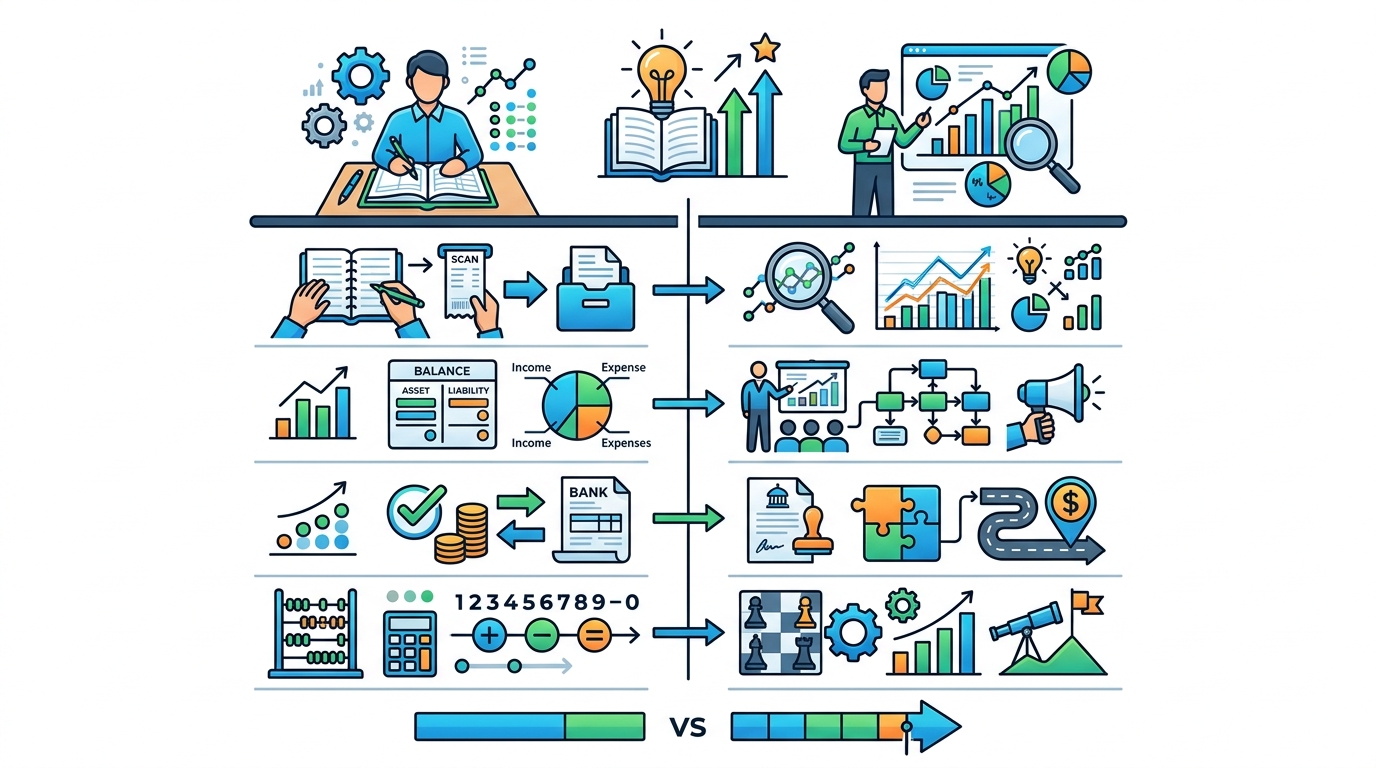
Bookkeepers record, code and check transactions; accountants interpret those records, prepare the reports built on them and carry regulatory responsibility for what those reports say. O*NET OnLine (U.S. Department of Labor, Employment and Training Administration), 2025, places bookkeeping, accounting and auditing clerks in Job Zone Three — vocational training, on-the-job experience or an associate's degree — and accountants and auditors in Job Zone Four, where most roles call for a four-year bachelor's degree.
The data entry, reconciliation and software skills transfer almost completely. The degree, the supervised experience and the licence do not, and in the United States licensing rules differ from state to state rather than being set nationally.
Side-by-Side Skills Comparison
Both columns are populated for every category. "Not required" means the category does not form part of the role as normally defined.
| Category | Bookkeeper | Accountant |
|---|---|---|
| Entry education | Job Zone Three: vocational training, related on-the-job experience or an associate's degree (O*NET OnLine (U.S. Department of Labor, Employment and Training Administration), 2025); surveyed employers named a high school diploma or equivalent, some a post-secondary certificate | Job Zone Four: most roles require a four-year bachelor's degree, though some do not; some surveyed employers named an associate's degree, some a post-baccalaureate certificate (O*NET OnLine, 2025) |
| Training and experience | One to two years combining on-the-job experience and informal training with experienced workers; a recognised apprenticeship may be associated with the occupation (O*NET OnLine, 2025) | Several years of work-related experience and on-the-job training; O*NET describes four years of college plus several years in accounting before someone is considered qualified (2025) |
| Core daily task | Operating computers programmed with accounting software to record, store and analyse information, and checking figures, postings and documents for correct entry, mathematical accuracy and proper codes (O*NET OnLine, 2025) | Preparing, examining or analysing accounting records and financial statements to assess accuracy, completeness and conformance to reporting and procedural standards (O*NET OnLine, 2025) |
| Tax work | Supporting only — gathering and coding the source documents a return is built from | Listed task: computing taxes owed and preparing tax returns, ensuring compliance with payment, reporting and other tax requirements (O*NET OnLine, 2025) |
| Knowledge areas | Six, including Customer and Personal Service, Administrative, Mathematics, and Economics and Accounting (O*NET OnLine, 2025) | Eight, including Economics and Accounting, English Language, Mathematics, Law and Government, and Administration and Management (O*NET OnLine, 2025) |
| Audit and assurance | Not required; clerks supply the records an auditor tests | Sample titles include Auditor, Financial Auditor, Internal Auditor and Audit Partner (O*NET OnLine, 2025) |
| Licensing | No single universal licence; O*NET links to a nationwide certification search and lists state licences state by state (2025), so check the board where you work | CPA (Certified Public Accountant) appears among O*NET's sample titles (2025); in the US licensing sits with each state board of accountancy, in Canada and the UK with a national professional accountancy body |
| Typical titles | Account Clerk, Accounting Assistant, Accounting Clerk, Accounting Specialist, Accounting Technician, Accounts Payable Clerk (O*NET OnLine, 2025) | Accountant, Accounting Officer, Cost Accountant, General Accountant, Financial Reporting Accountant, Internal Auditor (O*NET OnLine, 2025) |
Where the Gaps Are
The gap is not attitude or accuracy. It is four concrete things.
Formal education. O*NET OnLine (U.S. Department of Labor, Employment and Training Administration), 2025, puts bookkeeping clerks in Job Zone Three and accountants in Job Zone Four, where most occupations need a four-year bachelor's degree. A bookkeeping certificate does not substitute for degree-level study in the eyes of a licensing board.
Length of supervised experience. A clerk is usually trained within one to two years, much of it informally alongside experienced colleagues. An accountant, on O*NET's description, needs four years of college plus several years working in accounting before being considered qualified.
Named task responsibilities. Computing taxes owed and preparing returns, and analysing financial statements for conformance to reporting and procedural standards, are listed accountant tasks (O*NET OnLine, 2025). Checking figures, postings and codes sits on the clerk side. Moving across means owning the judgement call, not the data entry behind it.
Law and regulation. O*NET lists eight knowledge areas for accountants, including Law and Government, against six for clerks (2025). In practice that is statutory filing deadlines, disclosure rules and who may legally sign a set of accounts.
Licensing is the sharpest break. O*NET names no universal licence for bookkeeping clerks and lists state licences individually, so requirements differ between one US state and its neighbour, and differ again outside the United States.
Closing the Gap
Confirm the sequence with the regulator before you spend money: education prerequisites normally have to be met before you may sit a licensing examination, and the order is set by the body that issues the licence.
- Identify the regulator for the place you want to practise. In the United States that is the board of accountancy in your state; O*NET OnLine (U.S. Department of Labor, Employment and Training Administration), 2025, lists state licences state by state rather than one national licence. In Canada or the United Kingdom it is the national professional accountancy body controlling the protected title.
- *Map your work against ONET's accountant task list.** Computing taxes owed, preparing returns and analysing financial statements for conformance to reporting standards (2025) show you what you have never been responsible for.
- Complete the degree-level education your regulator specifies. O*NET places accountants and auditors in Job Zone Four, where most occupations require a four-year bachelor's degree (2025). Ask the board or national body which credit hours and subjects it accepts, and ask the institution whether your bookkeeping certificate earns any exemption.
- Log the supervised accounting experience the licence requires. O*NET describes several years of work-related experience and on-the-job training for this zone (2025). Supervision is normally by a licence holder, recorded as the board specifies.
- Apply through your regulator to sit the licensing examination. CPA appears among O*NET's sample titles (2025); in the US, eligibility, application and fees run through the state board of accountancy. Check its current fee schedule directly, in local currency.
- Register for continuing professional development. Renewal usually depends on it, and the issuing body publishes the hours and acceptable providers.
Qualification Equivalents
| Bookkeeper Credential | Accountant Equivalent | Gap or Extra Requirement |
|---|---|---|
| High school diploma or equivalent, named by some surveyed employers for bookkeeping clerks (O*NET OnLine (U.S. Department of Labor, Employment and Training Administration), 2025) | No direct equivalent — accountant roles sit in Job Zone Four, where most require a bachelor's degree (2025) | Degree-level study; confirm accepted subjects with your state board of accountancy or national accountancy body |
| Post-secondary bookkeeping certificate, named by some surveyed employers (O*NET OnLine, 2025) | Partial equivalent to foundation accounting coursework only | Remaining degree credits; ask institution and regulator separately about exemptions |
| Apprenticeship or one to two years of clerk training (O*NET OnLine, 2025) | Counts as practical exposure, not as licensed experience | Several years of accounting experience, usually logged under a licence holder |
| Accounting software proficiency — recording, storing and analysing information (O*NET OnLine, 2025) | Directly equivalent; assumed rather than credentialed on both sides | None, beyond the systems a given employer uses |
| Accounting Technician or Accounting Specialist title (O*NET OnLine, 2025) | No direct equivalent to Accountant or Auditor as a protected title | Education, experience and licensing as set by the issuing body in your jurisdiction |
| No universal bookkeeping licence; O*NET lists state licences individually (2025) | Licensed titles such as CPA (O*NET OnLine, 2025) | Full licensing route — varies by US state and by country |
Frequently Asked Questions
Can I become an accountant without a degree if I already work as a bookkeeper?
Sometimes. O*NET OnLine (U.S. Department of Labor, Employment and Training Administration), 2025, says most accountant and auditor occupations require a four-year bachelor's degree but some do not. Unlicensed accounting roles may accept experience; a licensed title such as CPA will not. Ask the board of accountancy or national accountancy body in your jurisdiction what it accepts.
Does my bookkeeping experience count towards an accountancy licence?
Usually only partly. O*NET describes bookkeeping clerk training as one to two years of on-the-job and informal learning, while accountants need several years of work-related experience (2025). Most licensing bodies require experience supervised by a licence holder and logged to their own template, so ask yours before assuming past years as a bookkeeper will qualify.
Do bookkeepers need a licence at all?
There is no single universal one. O*NET OnLine (U.S. Department of Labor, Employment and Training Administration), 2025, links to a nationwide certification search and lists state licences state by state rather than naming one licence for bookkeeping clerks. Requirements differ between US states and again between countries, so check the licensing authority where you actually work.
Sources
- O*NET OnLine (U.S. Department of Labor, Employment and Training Administration) — 43-3031.00 - Bookkeeping, Accounting, and Auditing Clerks (2025)
- O*NET OnLine (U.S. Department of Labor, Employment and Training Administration) — 13-2011.00 - Accountants and Auditors (2025)