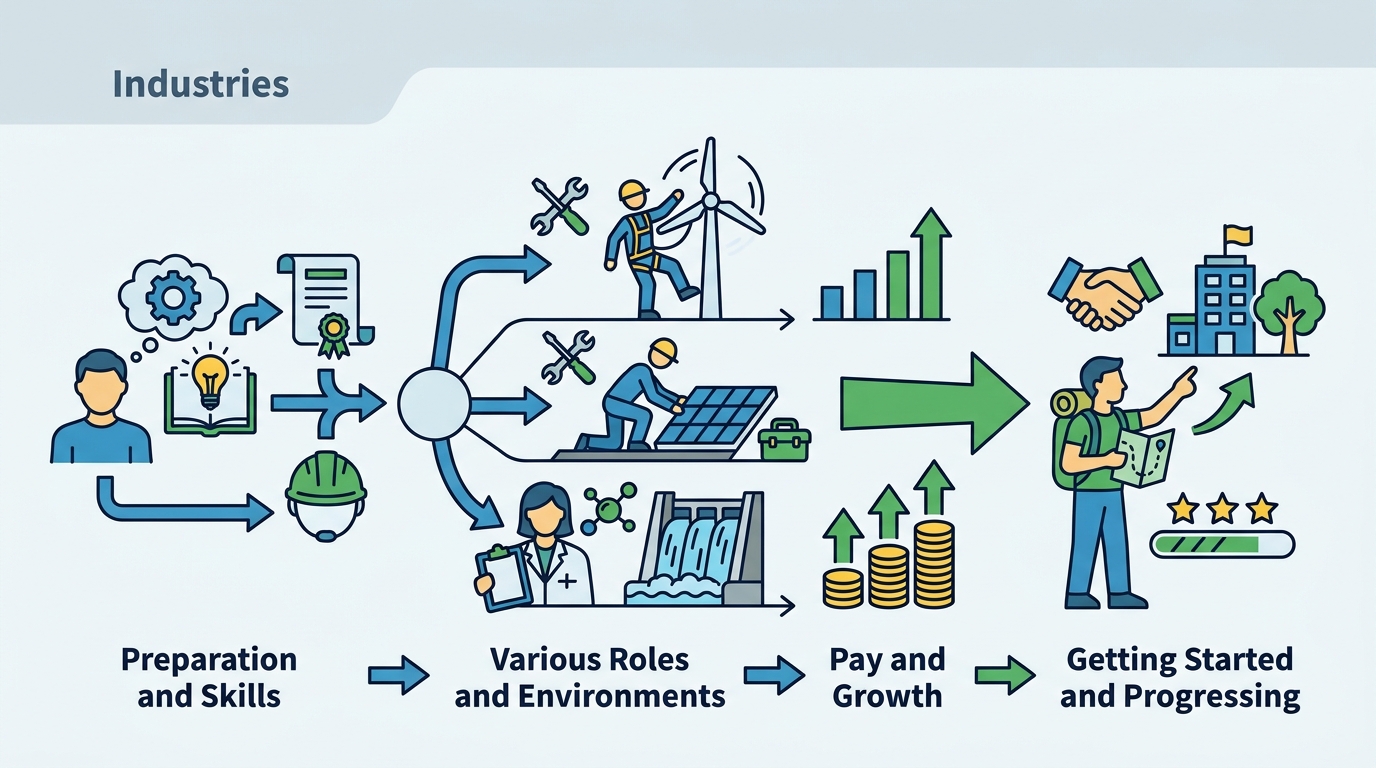
Renewable energy is not one job market but several: wind, solar, hydro, bioenergy, storage and the grid work that connects them. Most hiring sits in two places — site technicians who install, commission and maintain equipment, and engineers, analysts and project staff who design, consent and finance it.
Entry routes, job titles, licensing and pay differ sharply by country and by employer. This guide explains the work, the main routes in, and the named official sources — such as the U.S. Bureau of Labor Statistics and the UK's National Careers Service — where you should check current pay before you commit to a path.
What the Industry Involves
The sector splits into recognisable sub-sectors, and the day job in each one is different.
Onshore and offshore wind. Employers are typically wind farm owner-operators, turbine manufacturers' service divisions, and independent operations-and-maintenance (O&M) contractors. Technicians climb towers in harness, carry out scheduled servicing on gearboxes, pitch systems and yaw drives, torque and tension bolts to a written specification, replace sensors and converter components, and close out each job in a maintenance management system. Offshore crews add vessel or helicopter transfers, sea-state restrictions and rotation patterns away from home.
Solar photovoltaic. Employers range from residential installation companies and electrical contracting firms to utility-scale EPC (engineer, procure, construct) contractors. Work includes roof surveys and structural checks, mounting rails and racking, running DC string cabling, terminating into inverters and isolators, commissioning and string testing, and handing over paperwork to the customer and the network operator.
Grid, storage and heat. Distribution and transmission network operators, battery storage developers and heat pump installers all sit inside the same labour market. Tasks here include connection applications, protection settings, commissioning battery containers and SCADA points, and surveying homes for low-carbon heating.
Development, engineering and commercial. Developers, engineering consultancies, utilities and asset managers employ energy engineers, planning and consenting staff, environmental specialists, performance analysts and procurement teams. A typical week is site yield modelling, reviewing contractor method statements, responding to planning consultees, and reporting plant availability to an owner.
In the UK, the National Careers Service treats "renewable energy technician" as an alternative title for wind turbine technician and "renewable energy engineer" as an alternative title for energy engineer, so search both when you look at job profiles and vacancies.
The sector also matters economically: the Office for National Statistics data on the UK renewable energy sector's contribution to the economy was cited in a 2023 University of the Built Environment summary of the industry.
Roles and Typical Pay
Pay figures move every year and differ by country, employer, shift pattern and offshore allowance, so the table points you to the named body that publishes each number rather than quoting a figure that may already be out of date. Check the source listed before any interview.
| Role | Core tasks | How pay is usually structured | Where to check current figures |
|---|---|---|---|
| Wind turbine technician (onshore) | Scheduled servicing, fault-finding, component replacement, working at height | Annual salary or hourly rate, plus call-out, overtime and travel allowances | Median annual wage in US dollars from the U.S. Bureau of Labor Statistics (2025); salary range in pounds sterling from the UK National Careers Service job profile; national average for the role from Indeed UK |
| Offshore wind O&M technician | Vessel or helicopter transfers, turbine servicing, confined-space and height work | Base salary plus offshore or rotation allowance, set by employer agreement | UK National Careers Service wind turbine technician profile for the base range in pounds sterling; employer job adverts for offshore uplift |
| Solar photovoltaic installer | Racking, DC string wiring, inverter termination, commissioning and testing | Commonly hourly with overtime; crew leads paid above installer rate | Median annual wage in US dollars from the U.S. Bureau of Labor Statistics (2025) |
| Energy engineer / renewable energy engineer | Yield and system modelling, design reviews, commissioning oversight, performance reporting | Annual salary, often with graduate and chartered pay bands | UK National Careers Service energy engineer profile, in pounds sterling; the same National Careers Service range was cited by the University of the Built Environment for Renewable Energy Engineer |
| Electrician working on solar and storage | Consumer unit and isolator work, earthing, inverter connection, testing and certification | Hourly or day rate; certified installers may command more | U.S. Bureau of Labor Statistics occupational wage data (2025) for US rates; Indeed UK for advertised UK rates |
| Project developer / energy analyst | Site screening, consenting, grid applications, financial and generation modelling | Annual salary, frequently with an annual bonus element | Employer adverts and job boards such as Indeed UK; UK National Careers Service energy engineer profile as a reference point |
Two cautions. First, advertised averages on job boards reflect what employers posted, not what the whole workforce earns. Second, in wind and offshore work a large share of take-home pay can come from allowances and overtime, so compare total packages, not headline salaries.
How to Get In
- Pick the sub-sector and the country first. Installation, O&M and development hire differently, and qualifications rarely transfer across borders without re-certification. If you are in the UK, start from the National Careers Service job profiles for wind turbine technician and energy engineer; if you are in the US, start from the U.S. Bureau of Labor Statistics occupational profiles.
- Check the typical entry-level education for the occupation you want. The U.S. Bureau of Labor Statistics publishes a typical entry-level education level for both wind turbine technicians and solar photovoltaic installers in its 2025 profiles. These are the benchmark against which employers write their adverts.
- Take the trade or technical route if you want to work on site. Electrical or mechanical training, an apprenticeship, or a college technical qualification is the normal foundation for turbine and PV work. In the UK, apprenticeship and college routes are both listed on the National Careers Service wind turbine technician profile.
- Get the site safety card your employer requires before you apply, not after. In the US, an OSHA 10 card is one of the stated prerequisites on the route into NABCEP PV Installation Professional certification, alongside 58 hours of advanced PV installation training and a minimum age of 18 (Midwest Renewable Energy Association, undated).
- Add certification once you have installation experience. The NABCEP PV Installation Professional Certification is a voluntary board certification that sets standards allowing certified installers to distinguish themselves professionally (North American Board of Certified Energy Practitioners, 2023). It is a market signal rather than a licence to work.
- Plan for recertification from day one. Maintaining NABCEP PV Installation Professional certification involves completing an application documenting the requirements, signing the NABCEP Code of Ethics, paying application and examination fees, and completing continuing education and installation requirements plus a recertification fee (North American Board of Certified Energy Practitioners, 2012). Budget time and money for it.
- For engineering and development roles, choose a degree subject that maps to the plant. Electrical, mechanical, electrical power, civil or environmental engineering are the usual feeders into energy engineer roles; the UK National Careers Service energy engineer profile lists the routes and the alternative title "renewable energy engineer".
- Search under every title the role uses. Vacancies appear as renewable energy technician, wind turbine technician, PV installer, O&M technician and energy engineer. In the UK, Indeed UK is one of the job boards that aggregates these and publishes a national average salary for wind turbine technician roles.
Who This Suits
- You can climb a tower ladder in a full harness carrying hand tools and spares, then work inside a nacelle for a full shift without needing to come down.
- You are steady at height on a pitched roof in wind and rain, because that is where PV racking and module mounting happen.
- You can follow a torque specification exactly and record the value you applied, rather than tightening by feel.
- You read single-line diagrams and string layouts before you terminate anything, and you can trace a DC fault back through combiner boxes.
- You are content writing up service reports and commissioning data at the end of a physical day, because unrecorded work counts as work not done.
- You accept rotation patterns and overnight stays away from home, which is standard for offshore and remote onshore sites.
- You can explain an inverter alarm, an export arrangement or a metering change to a homeowner who has no technical background.
- You keep safety documentation current — site cards, rescue-at-height refreshers, electrical competence evidence — and you will sit a written exam and pay fees for certification such as the NABCEP PV Installation Professional (North American Board of Certified Energy Practitioners, 2012).
- For development and engineering roles, you can build and sanity-check a generation or cashflow model, and defend its assumptions to a planning consultee or an asset owner.
Industry Outlook
Base your expectations on published projections rather than headlines. In the United States, the U.S. Bureau of Labor Statistics publishes projected employment growth for wind turbine technicians over the decade 2025–2035, together with the projected average annual job openings for the occupation across that period (2025). It publishes the equivalent 2025–2035 growth projection and projected average annual openings for solar photovoltaic installers in the same 2025 release. Both profiles sit in the Occupational Outlook Handbook, are updated on a published schedule, and carry the typical entry-level education and median annual wage in US dollars alongside the projections — so one page gives you the pay benchmark and the demand picture together.
In the UK, the renewable energy sector's contribution to the economy was reported from Office for National Statistics data and cited in a 2023 University of the Built Environment overview of the industry. For role-level expectations, the National Careers Service publishes salary ranges in pounds sterling for wind turbine technician and energy engineer, and Indeed UK publishes a national average for advertised wind turbine technician roles; comparing the two tells you how advertised pay sits against the official range.
What this means practically: demand in wind and solar is driven by build-out pipelines and by the maintenance backlog on plant already commissioned, so O&M roles persist even when new-build slows. Before you train, check the current figures on the named sources above for your own country, and look at the project pipeline in your region — a single large wind farm or solar portfolio can dominate local hiring for years.
Frequently Asked Questions
Do I need a degree to work in renewable energy?
Not for most site roles. The U.S. Bureau of Labor Statistics states a typical entry-level education for wind turbine technicians and a separate one for solar photovoltaic installers in its 2025 occupational profiles, and neither occupation is treated as a graduate entry route. Degrees matter more for energy engineer roles, which the UK National Careers Service also lists under the title renewable energy engineer.
Is NABCEP certification legally required to install solar in the US?
No. The North American Board of Certified Energy Practitioners describes the PV Installation Professional Certification as a voluntary board certification that sets standards allowing certified installers to distinguish themselves professionally (2023). Electrical licensing and permitting are separate and are handled at state and local level, so check the rules for the state you will work in.
What does it take to keep NABCEP certification once I have it?
Holders must complete an application documenting the requirements, sign the NABCEP Code of Ethics, pay application and examination fees, and complete continuing education and installation requirements plus a recertification fee (North American Board of Certified Energy Practitioners, 2012). Treat it as an ongoing cost and time commitment, not a one-off exam.
What are the minimum prerequisites for the PV Installation Professional route?
One published route requires 58 hours of advanced PV installation training, an OSHA 10 card and a minimum age of 18 (Midwest Renewable Energy Association, undated). Training hours can usually be accumulated before you have full installation experience, so you can start the clock early.
Where should I check UK pay for these roles?
The National Careers Service publishes salary ranges in pounds sterling on its wind turbine technician profile (listed with the alternative title renewable energy technician) and on its energy engineer profile (alternative title renewable energy engineer). Indeed UK publishes a national average salary for advertised wind turbine technician roles, which is useful as a cross-check against the official range.
Do renewable energy jobs exist outside technical trades?
Yes. Developers, utilities and consultancies employ planning and consenting staff, environmental specialists, procurement and contract managers, performance analysts and asset managers, and these roles sit alongside the engineer profiles described by the UK National Careers Service. They hire on project and commercial experience rather than site certification.
Sources
- U.S. Bureau of Labor Statistics — Wind Turbine Technicians : Occupational Outlook Handbook (2025)
- U.S. Bureau of Labor Statistics — Solar Photovoltaic Installers : Occupational Outlook Handbook (2025)