
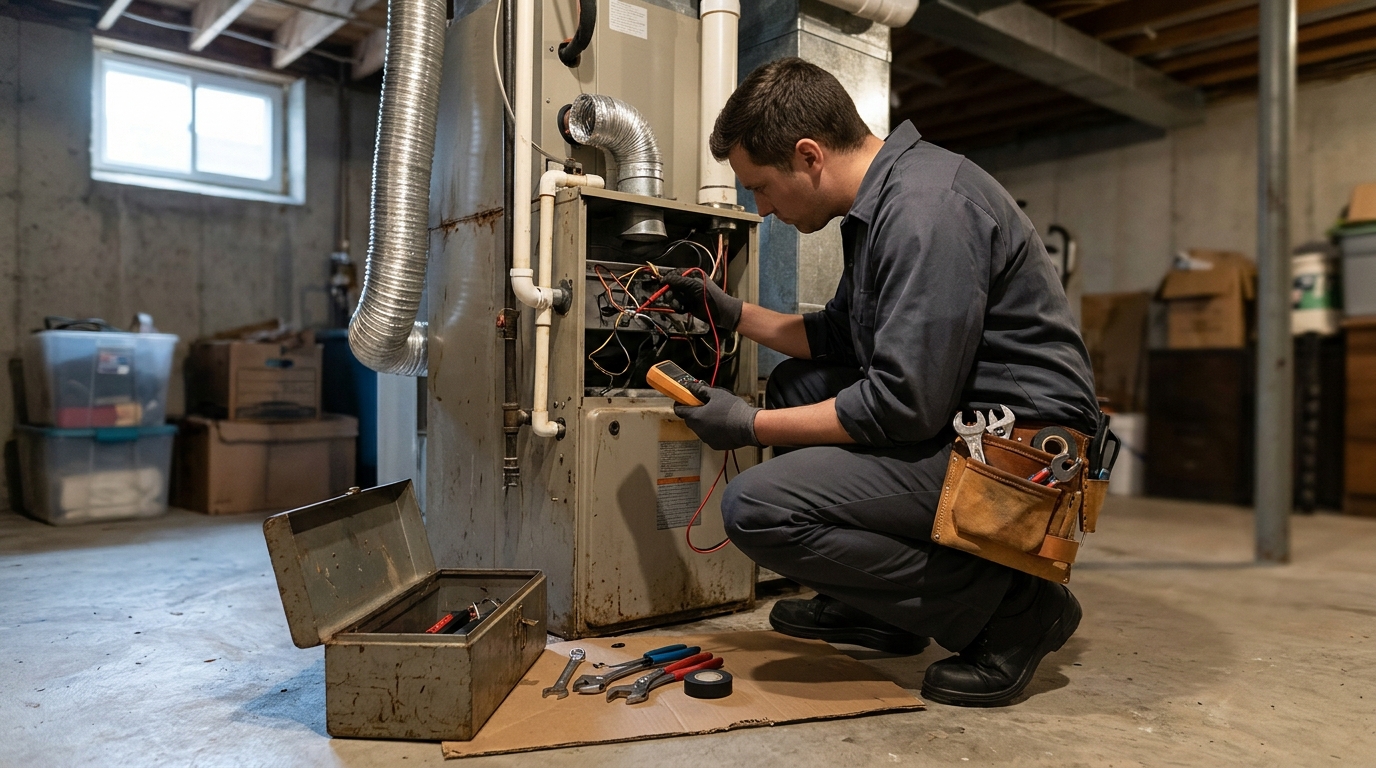
An HVAC technician installs, services and repairs heating, ventilation, air conditioning and refrigeration systems — in homes, shops, offices, factories and cold stores. O*NET OnLine (U.S. Department of Labor, undated) lists reported job titles for the occupation including AC Mechanic, HVAC Installer, HVAC Mechanic, HVAC Service Tech and Refrigeration Technician, which tells you how wide the work can be.
Most people enter through an apprenticeship or a vocational certificate rather than a university degree, and in many countries you need a separate licence or certification before you are allowed to handle refrigerant at all.
A Day in the Life
A service day usually starts with a job list on a phone or tablet, a van stock check and a drive to the first call. You might begin on a split system that is cooling poorly: strip the covers, read superheat and subcooling off a digital manifold gauge set, check amp draw at the compressor with a clamp meter, and test the capacitor before you blame the compressor. If the charge is low, you look for the leak with an electronic detector or UV dye rather than topping it up and driving away.
Refrigerant work is the part that is legally controlled in many countries. You recover the charge into a recovery cylinder with a recovery machine, pull the system into vacuum with a two-stage pump and a micron gauge, braze the repair with nitrogen flowing through the pipe, then weigh in a new charge. O*NET OnLine (U.S. Department of Labor, undated) lists connecting heating or air conditioning equipment to fuel, water or refrigerant sources to form a complete circuit among the occupation's core tasks, alongside installing energy-efficient HVAC equipment.
Install days look different again. The National Careers Service (UK government, undated) describes the heating and ventilation engineer's duties as following design blueprints to fit heating equipment and pipework, installing ductwork and ventilation systems, and designing and installing control panels that adjust heating systems. That means measuring and cutting duct, setting anchors into concrete soffits, pressure-testing pipework, pulling control cable, and commissioning with an anemometer and manometer so the airflow matches the design drawing.
Paperwork closes every job: commissioning sheets, refrigerant logs, parts used, photos of the install, and a note to the customer about what failed. Hours are not always nine to five — the National Careers Service (UK government, undated) notes the role may involve evening and weekend work, and planned maintenance on shops, data rooms and kitchens is often done when the building is closed. On-call rotas for breakdowns are common in commercial and refrigeration work.
O*NET OnLine (U.S. Department of Labor, undated) shows the occupation's employment concentrated in construction, so on new-build sites you also work to a programme, attend site inductions and coordinate with electricians and plumbers for ceiling space.
Salary and Progression
Pay in this trade is usually set as an hourly rate or an annual salary depending on the country and employer, then topped up by overtime, standby allowances, call-out payments and sometimes a van and fuel card. Rates move with region, sector (domestic versus commercial refrigeration) and whether you hold the licences that let you sign work off, so always check a current national source rather than a figure quoted in a forum.
| Stage | What the work looks like | How pay is usually structured |
|---|---|---|
| Apprentice / trainee | Assisting on installs, carrying and cutting duct, handing tools, college or block-release study | A training rate that steps up each year of the apprenticeship; study time usually paid |
| Improver / second-year tech | Running simple services supervised, brazing, basic fault-finding | Hourly rate, with overtime and travel time depending on employer |
| Qualified technician | Own van, own job list, diagnosing and repairing unsupervised, handling refrigerant under licence | Hourly rate or salary plus call-out and standby payments |
| Senior / commercial or refrigeration specialist | Chillers, VRF, cold stores, commissioning and controls | Premium over the general rate; shift and out-of-hours loading common |
| Supervisor, estimator or contracts manager | Pricing jobs, running teams, client sign-off | Salaried, often with a bonus tied to project margin |
Where to check current rates in your country:
- United Kingdom — the National Careers Service (UK government, undated) publishes an average salary for heating and ventilation engineers, and the ONS Annual Survey of Hours and Earnings reports median gross annual pay for air-conditioning and refrigeration installers and repairers under SOC 5225 (Office for National Statistics ASHE, as reported by CareerMetrics, 2025).
- Canada — the Government of Canada's Job Bank reports wage ranges for heating, refrigeration and air conditioning (HRAC) mechanics across Canada (2025), with regional prevailing wage bands such as the British Columbia data covering the Vancouver area (Job Bank, 19 November 2025).
- Australia — Jobs and Skills Australia's Job Outlook reports median full-time weekly earnings for airconditioning and refrigeration mechanics, drawn from the ABS Survey of Employee Earnings and Hours (undated).
- United States — start with the CareerOneStop occupation profile (U.S. Department of Labor, undated), which also sets out the typical education and experience requirements.
Progression is not only upward in pay grade. The National Careers Service (UK government, undated) states that with further training a heating and ventilation engineer could become a building services engineer, facilities manager or heat pump engineer.
Entry Routes and Qualifications
Routes differ sharply by country, so work backwards from the licence you will need rather than from the course that is easiest to book.
- Check the refrigerant rules first. In the United States, Section 608 of the Clean Air Act requires technicians who maintain, service, repair or dispose of equipment that could release ozone-depleting refrigerants to hold certification (U.S. Environmental Protection Agency, undated). The Air Conditioning Contractors of America (ACCA), an EPA-approved certifying organisation, states that a technician must be certified under Section 608 to work on stationary air conditioners and refrigeration systems in the US (ACCA, undated). Other countries run their own refrigerant handling schemes through environment or licensing authorities — confirm which applies before you enrol anywhere.
- Vocational certificate route. CareerOneStop (U.S. Department of Labor, undated) lists the typical education requirement for the occupation as a postsecondary certificate and the experience requirement as no work experience. O*NET OnLine classifies the occupation as Job Zone Three, Medium Preparation Needed, noting that such roles typically need vocational school training, related on-the-job experience or an associate's degree, and that a recognised apprenticeship programme may be associated with the occupation (U.S. Department of Labor, as summarised by tradecareerpath.com, undated). A full-time certificate can take well under a year; you then still need employer time on the tools.
- Apprenticeship route. This is the standard path in the UK and Canada: paid work with a contractor plus college attendance. Apprenticeships in this trade commonly run three to four years before you are treated as fully qualified, because the classroom units have to be matched by logged site hours. In Canada, apprenticeship registration and trade certification sit with the provincial or territorial apprenticeship authority, and the Government of Canada's Job Bank (2025) sets out the occupation as heating, refrigeration and air conditioning (HRAC) mechanic.
- Australia. A visa-pathway guide citing the ANZSCO classification notes that airconditioning and refrigeration mechanics carry a defined skill level and a qualification requirement (AustralianVisaOnline.com, 2026). Check the current ANZSCO entry and your state or territory licensing body, because electrical and refrigerant handling permissions are separate from your trade qualification.
- Build the extras that unlock work. Gas, electrical testing, work-at-height, confined space and heat pump units are usually added after the core qualification and are often what decides which jobs you can be sent to on your own.
- Join a professional body. The National Careers Service (UK government, undated) notes that engineers can join the Chartered Institute of Plumbing and Heating Engineering (CIPHE) for professional development.
Skills and Qualities Needed
- Systematic fault-finding — reading superheat and subcooling before condemning a compressor, instead of replacing parts until the fault stops.
- Drawing literacy — following design blueprints to fit heating equipment and pipework, and setting out ductwork so it clears the ceiling void first time (duties described by the National Careers Service, UK government, undated).
- Hand skill under pressure — brazing a joint overhead with nitrogen flowing, on a shop refrigeration pack that has to be back on before stock warms up.
- Respect for regulated materials — recovering a charge into a cylinder rather than venting it, because venting regulated refrigerants is prohibited under Section 608 (U.S. Environmental Protection Agency, undated).
- Electrical confidence — isolating, locking off and proving dead before opening a control panel, then testing contactors and sensors with a multimeter.
- Customer handling — explaining to a shop owner why the cold room failed and what it will cost, without jargon and without over-promising a same-day fix.
- Record keeping — logging refrigerant added and recovered, and completing commissioning sheets that a building inspector or client may ask to see years later.
- Physical stamina and head for heights — a plant room ladder, a roof-mounted condenser and a day of lifting duct sections are routine, not exceptions.
- Flexibility on hours — the National Careers Service (UK government, undated) notes evening and weekend work can be part of the job, which matters if you have fixed caring commitments.
Similar Roles to Consider
- Refrigeration technician — listed by O*NET OnLine (U.S. Department of Labor, undated) among the reported titles for this occupation, but weighted towards cold stores, display cases and process cooling, with more out-of-hours call-out than comfort cooling work.
- HVAC installer — another title in the same O*NET list; installation is project-based with longer site runs and less diagnostic work than a service technician's day.
- Heat pump engineer — named by the National Careers Service (UK government, undated) as a step a heating and ventilation engineer can take with further training; the work leans on low-temperature system design and domestic retrofit rather than breakdown repair.
- Building services engineer — also listed by the National Careers Service as a progression route; it is a design and specification role based around drawings and calculations, usually requiring further study rather than more tool time.
- Facilities manager — the third progression option the National Careers Service names; you manage contractors, budgets and planned maintenance schedules instead of carrying out the repairs yourself.
Frequently Asked Questions
How hard is the EPA Section 608 exam in the United States?
The Section 608 technician certification exam has four categories — Type I, Type II, Type III and Universal. Each section contains 25 multiple-choice questions and you must score 18 out of 25 to pass that section (summary of EPA programme rules via Wikipedia, undated). Universal certification means passing all the relevant sections, and it does not expire in the way a licence renewal does, so many technicians sit it early in training.
What happens if a technician vents refrigerant deliberately?
It is treated as a Clean Air Act violation in the US, and the maximum civil penalty for such violations — including knowingly venting regulated refrigerants prohibited under Section 608 — is adjusted annually for inflation, with the current adjustment effective 8 January 2025 (U.S. Environmental Protection Agency, via Wikipedia, 2025). Check the current figure with the EPA, and check your own country's environment regulator for equivalent penalties.
Which industries employ the most HVAC technicians?
O*NET OnLine data shows the occupation's industry distribution concentrated in construction (U.S. Department of Labor, undated). In practice that means new-build and fit-out contractors, with the rest spread across building maintenance contractors, retail and food chains with refrigeration estates, and in-house facilities teams at hospitals and manufacturing plants.
Do I need a degree to become an HVAC technician?
No. CareerOneStop (U.S. Department of Labor, undated) lists the typical education requirement as a postsecondary certificate, and O*NET places the occupation in Job Zone Three, Medium Preparation Needed, where vocational school training, related on-the-job experience or an associate's degree is typical. Degrees matter more if you later move into building services design.
Is there a professional body worth joining?
In the UK, the National Careers Service (UK government, undated) points to the Chartered Institute of Plumbing and Heating Engineering (CIPHE) for professional development. In the US, the Air Conditioning Contractors of America (ACCA) is an EPA-approved certifying organisation for Section 608 and is a useful starting point for finding approved testing.
Sources
- O*NET OnLine (U.S. Department of Labor) — 49-9021.00 - Heating, Air Conditioning, and Refrigeration Mechanics and Installers
- CareerOneStop (U.S. Department of Labor) — Occupation Profile for Heating, Air Conditioning, and Refrigeration Mechanics and Installers