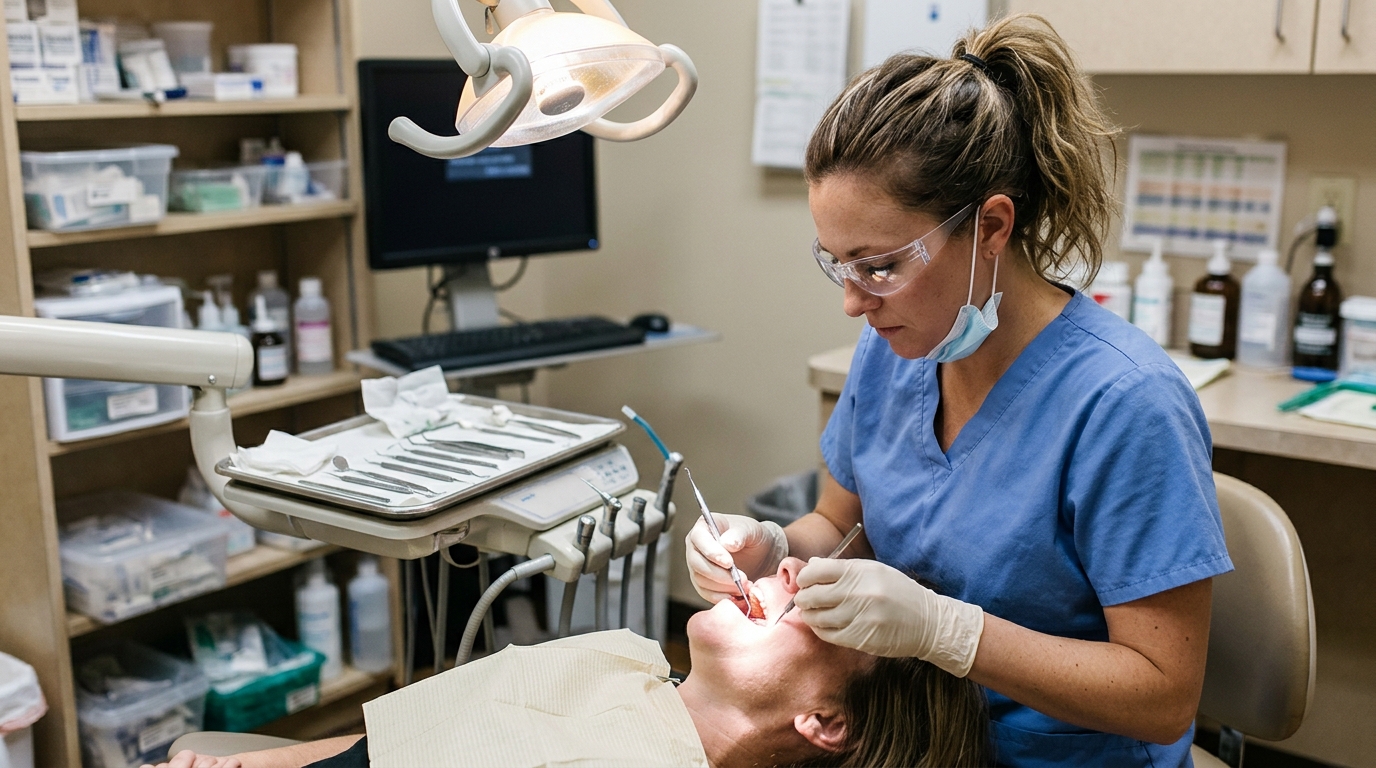
Dental hygienists clean, chart and protect patients' gums and teeth, usually working alongside dentists in general practice, hospital or community clinics. The work is hands-on: scaling, polishing, taking radiographs and coaching patients through what they do at home. Training is shorter than dentistry, but it is still a licensed clinical role with formal registration attached.
In the UK that means a course approved by the General Dental Council followed by GDC registration. In the United States, reported job titles for the occupation include Registered Dental Hygienist (RDH) and Licensed Dental Hygienist (O*NET OnLine (U.S. Department of Labor, using Bureau of Labor Statistics data), undated).
A Day in the Life
A clinic day runs on appointments of roughly 30 to 60 minutes, back to back, with a short gap between each for decontamination and notes.
You set up the surgery first: mirror, probe, sickle and curette scalers laid out, the ultrasonic scaler's water line and handpiece checked, and the patient's record open on the practice software so you can see last visit's charting.
The patient sits down and you update the medical history before anything else — new medication, pregnancy, anticoagulants, a recent diagnosis all change what you do next. Then you probe pocket depths around each tooth and record bleeding points.
The core task is removing deposits: cleaning calcareous deposits, accretions and stains from teeth and beneath the margins of the gums using dental instruments (O*NET OnLine (U.S. Department of Labor, using Bureau of Labor Statistics data), undated). Ultrasonic work first on heavier calculus, then hand instrumentation subgingivally, then polishing with prophy paste or an air polisher, often finishing with fluoride varnish.
Radiography is part of the job in many settings — exposing and developing x-ray film, or its digital equivalent, is a listed task for the occupation (O*NET OnLine (U.S. Department of Labor, using Bureau of Labor Statistics data), undated). You position the sensor, set exposure and check the image is diagnostic before the patient leaves the chair.
Then the part patients remember: showing someone how to angle a brush at the gum line, demonstrating interdental brushes on a model, talking through smoking or sugar without lecturing. It goes in the notes, because what you advised and what the patient consented to is a medico-legal record.
Between patients you wipe down and bag instruments for the ultrasonic bath and autoclave. Scope of practice varies: some hygienists give local anaesthetic or place fissure sealants, others do not, and that is set by your regulator and employer. A week may be all general practice, or split across a community clinic, a hospital periodontology department or a special care service.
Salary and Progression
No single figure covers this job. Pay is structured differently in salaried public systems and in private practice, and the currency depends on where you work. Published figures move each year, so check the current rate.
| Stage | How pay is structured | Where to check |
|---|---|---|
| Student (England) | Not a salary. Eligible students on a level 5 or 6 course may get at least £5,000 a year towards study, non-repayable (NHS Health Careers (Health Education England / NHS), undated), paid as an annual Training Grant (Prospects.ac.uk (Graduate Futures Institute & Jisc), 2026-10) | NHS Learning Support Fund guidance |
| Newly registered, NHS England | Agenda for Change salary, starting posts at band 5 (Prospects.ac.uk, 2026-10); NHS Health Careers notes starting salary might be at bands 5 or 6 (undated) | Current NHS Agenda for Change pay circular |
| Specialist | Band 6 for additional expertise or responsibilities (Prospects.ac.uk (Graduate Futures Institute & Jisc), 2026-10) | NHS Agenda for Change job profiles |
| Advanced | Band 7 for clinical leadership, supervision or training (Prospects.ac.uk (Graduate Futures Institute & Jisc), 2026-10) | NHS Jobs adverts; Prospects job profile |
| UK private practice | Hourly rate, sessional fee, or a percentage of treatment charges (Prospects.ac.uk (Graduate Futures Institute & Jisc), 2026-10) — income tracks list size and cancellations | British Society of Dental Hygiene and Therapy; Indeed UK; BDJ Jobs |
| United States | Salaried or hourly; O*NET OnLine publishes a median wage for Dental Hygienists (U.S. Department of Labor, using Bureau of Labor Statistics data, 2025) | O*NET OnLine; your state dental board for licensure-linked roles |
Progression is usually sideways before it is upward: periodontal referrals, tooth whitening under prescription, oral health promotion in schools, mentoring students, or adding dental therapy to your registration so you can restore teeth.
Entry Routes and Qualifications
Routes are named differently in each country. Use the names your regulator uses.
United Kingdom
- Check the academic bar. You'll need five GCSE subjects graded 4-7 or A-C, plus two or three A levels depending on the university, or a recognised dental nursing qualification, to get on to a dental hygiene course (NHS Health Careers (Health Education England / NHS), undated). Biology is commonly asked for.
- Choose a GDC-approved course. Approved routes include degrees in dental hygiene, oral health sciences, or dental hygiene and dental therapy, typically three years; diplomas; and a two-year foundation degree (FdSc) in Dental Hygiene at the University of Essex (Prospects.ac.uk (Graduate Futures Institute & Jisc), 2026-10).
- Apply for funding if you study in England. A non-repayable annual Training Grant is available through the NHS Learning Support Fund for eligible pre-registration students at level 5 or 6 (Prospects.ac.uk (Graduate Futures Institute & Jisc), 2026-10).
- Register with the GDC. To practise, you need a GDC-approved course and then registration with the General Dental Council (NHS Health Careers (Health Education England / NHS), undated). Registration is annual and carries continuing professional development requirements.
- Find a first post through NHS Jobs, the BDJ Jobs board or direct approaches to practices; many hygienists start with part-time sessions across two employers.
United States
- Expect a two-year college programme. In an employer survey for this occupation, 75% responded that an associate's degree or other 2-year degree is required (O*NET OnLine (U.S. Department of Labor, using Bureau of Labor Statistics data), undated).
- The occupation sits in Job Zone Three: Medium Preparation Needed, where employees usually need one or two years of training involving both on-the-job experience and informal training (O*NET OnLine (U.S. Department of Labor, using Bureau of Labor Statistics data), undated).
- Licensure is handled state by state. Check the requirements published by the dental board in the state you intend to work in before you enrol.
If you trained elsewhere, go to the destination country's regulator first — recognition of overseas qualifications is decided there.
Skills and Qualities Needed
- Manual dexterity — using dental instruments accurately and carrying out precise clinical treatments safely is named as a core requirement (Prospects.ac.uk (Graduate Futures Institute & Jisc), 2026-10); in practice, angling a curette blade under the gum margin on a lower molar without lacerating tissue.
- Attention to detail — spotting a 6mm pocket with bleeding on probing that was charted as 3mm last year, and flagging it rather than polishing over it.
- Radiographic judgement — re-exposing only when an image is genuinely non-diagnostic, because every retake is extra dose to the patient.
- Infection control discipline — bagging, tracking and autoclaving instruments in the right order and logging cycle checks, so the practice can prove compliance at inspection.
- Plain-language persuasion — getting a nervous smoker with bleeding gums to try interdental brushes for six weeks by demonstrating on a model, not handing over a leaflet.
- Medical history vigilance — noticing a new anticoagulant on the update form and adjusting the plan before you start subgingival work.
- Posture awareness — using loupes and resetting chair height between patients so you are not bent over all day; neck and back strain ends careers.
- Business sense in private practice — knowing whether you are paid hourly, by session or as a percentage of treatment charges (Prospects.ac.uk (Graduate Futures Institute & Jisc), 2026-10), and what short-notice cancellations do to your income.
Similar Roles to Consider
- Dental therapist — adds restorative work such as fillings and extraction of deciduous teeth to the hygiene scope; usually trained through a combined dental hygiene and dental therapy degree, typically three years (Prospects.ac.uk (Graduate Futures Institute & Jisc), 2026-10).
- Dental nurse — supports the clinician chairside rather than treating independently; a recognised dental nursing qualification is itself an accepted entry route onto a hygiene course (NHS Health Careers (Health Education England / NHS), undated).
- Orthodontic therapist — bonds brackets and changes archwires to an orthodontist's prescription, instead of periodontal charting and scaling.
- Dental technician — makes crowns, dentures and appliances in a laboratory with no patient contact; the overlap is fine motor work, not communication.
- Oral health educator — prevention work in schools and care homes, often salaried in public health services, with little or no instrumentation.
Frequently Asked Questions
How long does it take to qualify?
In the UK, dental hygiene, oral health sciences or combined hygiene and therapy degrees typically run three years, while the two-year foundation degree (FdSc) in Dental Hygiene at the University of Essex is shorter (Prospects.ac.uk (Graduate Futures Institute & Jisc), 2026-10). In the US, the occupation is Job Zone Three: Medium Preparation Needed, where one or two years of training combining on-the-job experience and informal training is usual, and a recognised apprenticeship programme may be associated with the occupation (O*NET OnLine (U.S. Department of Labor, using Bureau of Labor Statistics data), undated).
What hours would I work in the NHS?
NHS posts are typically 37.5 hours a week, with starting salaries at bands 5 or 6 of the Agenda for Change pay scale (NHS Health Careers (Health Education England / NHS), undated). Private practice is often organised in sessions rather than full days, which is why many hygienists hold two part-time contracts.
Is the job market growing?
Check the published projections rather than impressions. O*NET OnLine publishes a projected employment growth figure for Dental Hygienists for 2025-2035, an estimate of projected job openings over the same period, and the current employment level for the occupation (U.S. Department of Labor, using Bureau of Labor Statistics data, 2025). For the UK, look at vacancy volumes on NHS Jobs and the BDJ Jobs board in your region.
Do I have to register before I can work?
In the UK, yes — you must take a course approved by the General Dental Council and then register with the GDC (NHS Health Careers (Health Education England / NHS), undated). Registration is renewed annually and carries continuing professional development obligations. In the US, licensure is granted at state level, which is why reported titles include Registered Dental Hygienist (RDH) and Licensed Dental Hygienist (O*NET OnLine (U.S. Department of Labor, using Bureau of Labor Statistics data), undated).
Sources
- O*NET OnLine (U.S. Department of Labor, using Bureau of Labor Statistics data) — 29-1292.00 - Dental Hygienists (2025)
- NHS Health Careers (Health Education England / NHS) — Dental hygienist