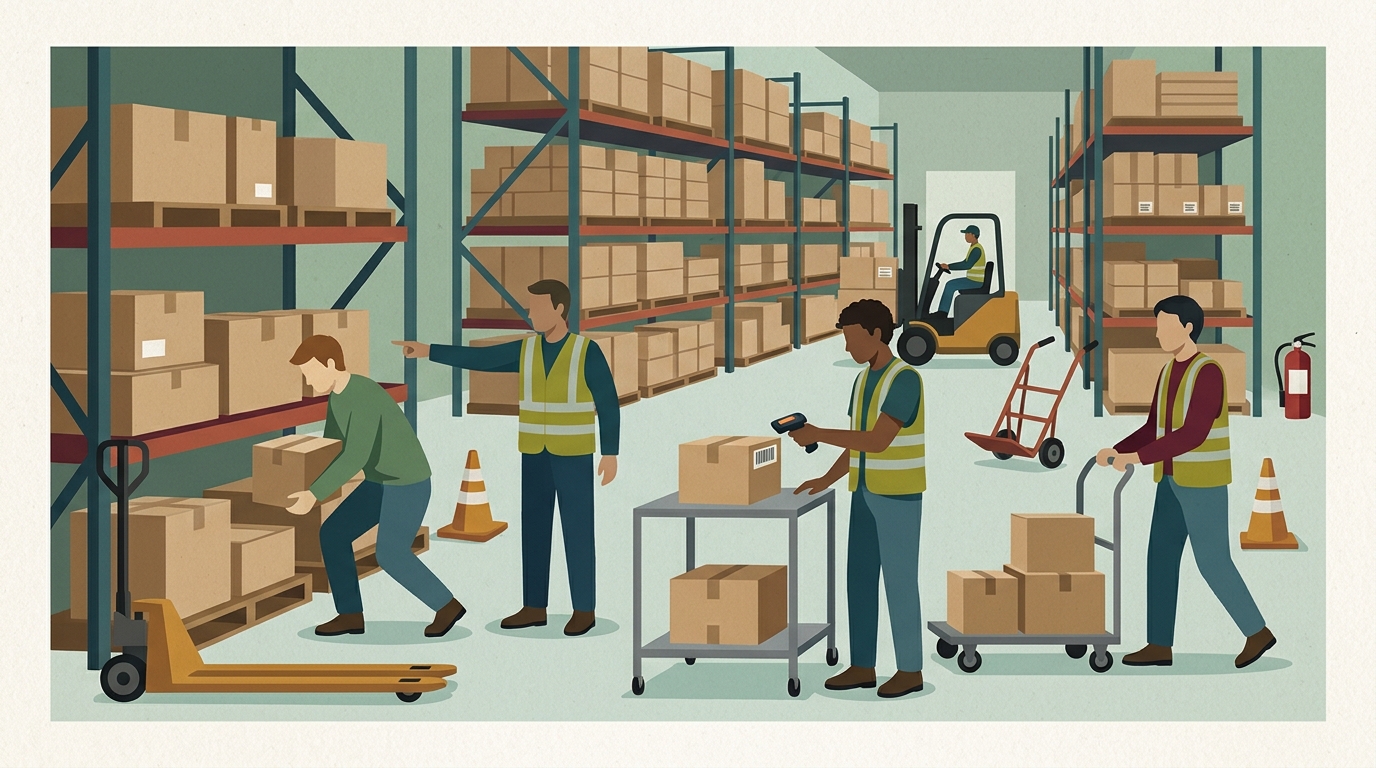
Warehouse hiring is quick and practical: an application screen, a skills or situational assessment, one interview built around safety and reliability, then a background check. Roles on powered equipment add a hands-on evaluation before you operate anything unsupervised.
Timing runs from a few days at a large distribution centre to a few weeks where licensing or driving records come into it.
How the Warehouse Hiring Process Works
Warehouse labour is hired through several channels at once. Large distribution centres recruit through their own career pages and on-site hiring events. Staffing agencies supply much of the temp-to-hire workforce, especially at peak season. Public portals carry listings too — Canada's Job Bank, the EU's EURES network, or your national or state employment service. Walk-in applications still work at smaller third-party logistics sites.
The stages are fairly consistent:
- Application screen. A short online or paper form. Employers check shift availability, right to work, and whether you can meet the physical demands.
- Phone or text screen. A recruiter confirms start date, shift pattern, transport to site and equipment experience.
- Assessment. Amazon's process includes a mandatory 20-minute interactive virtual job tryout testing problem-solving in operational scenarios (The Future Warehouse, 2026); DHL's includes a skills assessment and a safety knowledge test (Job-Applications.com, undated).
- Interview. Usually one round of competency and safety questions lasting 15 to 30 minutes, sometimes with a site tour or trial shift where the employer watches how you handle the environment (CareerTestPrep, 2026).
- Equipment evaluation. For forklift roles. In the United States, OSHA-compliant training combines formal instruction, hands-on practice and a workplace performance evaluation before unsupervised operation, under 29 CFR 1910.178 (ForkliftCertification.com, undated).
- Background check, then offer.
Pay is almost always hourly, often with shift differentials for nights and weekends. Rates vary by employer, region and country — check the posting itself and your national statistics agency's occupational wage data.
Titles differ for the same work: ONET lists Warehouse Worker, Material Handler, Loader and Receiving Associate among reported titles for Laborers and Freight, Stock, and Material Movers, Hand (ONET OnLine, 2026). Search all of them.
What to Expect From Application to Offer
| Stage | Typical duration | What the employer is evaluating |
|---|---|---|
| Application screen | Same day to 5 days | Shift availability, work authorisation, equipment experience, gaps in work history |
| Phone or text screen | 10-15 minutes, usually within a week | Whether you can reach site for the shift offered |
| Skills or situational assessment | 20-45 minutes online; Amazon's virtual job tryout runs 20 minutes (The Future Warehouse, 2026) | Numeracy, literacy, safety judgement, reaction to operational scenarios |
| Interview | 15-30 minutes (CareerTestPrep, 2026); 20-30 minutes with 3-5 behavioural questions at Amazon associate level (JobHelpGuide, 2026) | Safety awareness, attendance, teamwork on a pick line or dock |
| Site tour or trial shift | 30 minutes to a full shift | How you cope with noise, cold storage, pace and lifting |
| Forklift training and evaluation | Hours to 2 days, usually after hire | Hands-on competence; performance reevaluated at least every three years (J. J. Keller & Associates, undated) |
| Background check | 3-7 days at DHL (Job-Applications.com, undated); a single-county criminal check with a rapid oral-fluid drug test can finish same- or next-day (Lingo Staffing, undated) | Identity, criminal history, drug screen, plus driving record for equipment or driver roles (iprospectcheck, 2026) |
| Offer to start | 2-5 business days for a general associate (Zyverno, undated); 15 days for a Walmart Warehouse Associate (Job-Applications.com, undated); 1-3 weeks at Amazon (The Future Warehouse, 2026) | Final clearance and shift placement |
Through an agency the front end is longer: general warehouse associate roles are sourced in two to three weeks in a distribution-centre staffing model (Zyverno, undated). Roles needing a commercial driver's licence run one to two weeks minimum because of United States Federal Motor Carrier Safety Administration compliance steps (Zyverno, undated).
Common Warehouse Interview Questions and How to Answer Them
"Walk me through the checks you'd do on a forklift before your shift."
Name the sequence: horn, lights, brakes, steering, forks and mast, hydraulic leaks, tyre condition, data plate, load chart, seatbelt, battery or fuel level. Say what you do when something fails — tag it out and report it, don't drive it. If you have not operated before, say so and describe what you expect to be trained on.
"The quantity in the pick location doesn't match your pick list. What do you do?"
They want to hear that you don't guess and don't short the order silently. Describe scanning the location to confirm the slot, checking the reserve or overstock location, then raising the discrepancy with a lead or through the WMS.
"This role involves lifting and standing for a full shift. How do you manage that?"
Canada's Job Bank notes that material handlers working with heavy materials need sufficient physical strength to do the job safely (Hire Labour citing Canada's Job Bank, 2027). Answer with technique and pacing: team lifts, a pallet jack rather than carrying, hydration, rotating tasks. Note that before an offer an employer generally may not ask about disabilities, past injuries, workers' compensation claims or medical history, per United States EEOC enforcement guidance on pre-employment disability-related questions (FirstHR, undated).
"Tell me about a time you spotted a safety hazard."
A spill, a damaged pallet, a blocked fire exit, a racking strike, a trailer not chocked. Say what you saw, what you did immediately, who you told, and what changed afterwards.
Sample Answer to a Tough Warehouse Interview Question
"Tell me about a mistake you made that cost the operation time or product."
Spoken-style answer
"On an evening shift I was loading a trailer at door 14 and pulled a pallet from the staging lane without rescanning the label. It looked right — same product, same wrap — but it was staged for a different store, and it went on the trailer. I only realised when the dock sheet came up one pallet short for the other load.
I told the shift lead straight away rather than letting it sort itself out at the receiving end. We had sealed the trailer, so he made the call to break the seal, pull the pallet and reload. It cost about 40 minutes and we dispatched late.
What I took from it is that the scan is the check, not the wrapping. I now scan every pallet at the door even when I'm certain, and if I'm interrupted mid-load I restart the scan rather than carry on from memory. No mis-loads since."
Frequently Asked Questions
What should I wear and bring to a warehouse interview?
Unless the employer says otherwise, business-casual clothing is generally a safe choice (Hire Labour, 2027). Wear closed-toe shoes: if the process includes a site tour or trial shift (CareerTestPrep, 2026), open footwear will keep you off the floor. Bring a few copies of your resume, any certification or training records, and identification if requested (Hire Labour, 2027).
Should I say I have no warehouse experience?
Yes, and pair it with what transfers: retail stocking, kitchen work, construction labouring, military logistics. Many associate roles are built around on-site training, and the employer is mainly testing attendance, safety judgement and whether you'll stay. Don't claim forklift experience you don't have — it surfaces at the hands-on evaluation.
Do I need a driving licence to operate a forklift?
Not under United States federal rules. Federal OSHA has no requirement that a forklift operator hold a valid motor vehicle driver's licence; the employer's own certification record documenting completed training is the only 'licence' OSHA requires (J. J. Keller & Associates, undated). A card from a previous employer does not authorise you to run equipment at a new one — the new employer must train and evaluate you itself (FirstHR, undated). Other countries run their own schemes, so check the national workplace safety regulator where you apply.
How should I follow up?
These processes move quickly — two to five business days to an accepted offer for a general associate role (Zyverno, undated) — so follow up after three to four business days by phone or text to the recruiter, not email alone. If you applied through a staffing agency, call the branch and ask to be put forward for the next start date; agencies fill in batches.
Sources
- O*NET OnLine (National Center for O*NET Development) — 53-7062.00 - Laborers and Freight, Stock, and Material Movers, Hand (2026)
- J. J. Keller & Associates — OSHA's Forklift Training Frequently Asked Questions