Dental hygienists examine patients for signs of oral disease such as gingivitis and provide preventive care, including oral hygiene instruction (U.S. Bureau of Labor Statistics, 2026-10-29). Getting there means completing an accredited dental hygiene programme and then qualifying for a licence — in the United States, all states require hygienists to be licensed, and the requirements vary by state (U.S. Bureau of Labor Statistics, 2026-10-29).
This guide covers the daily work, the credentials regulators and employers ask for, the order to tackle them in, and where vacancies are actually advertised. Regulators, exams and scope of practice differ by country and by state or province, so check your own regulator before enrolling anywhere.
What a Dental Hygienist Does Day to Day
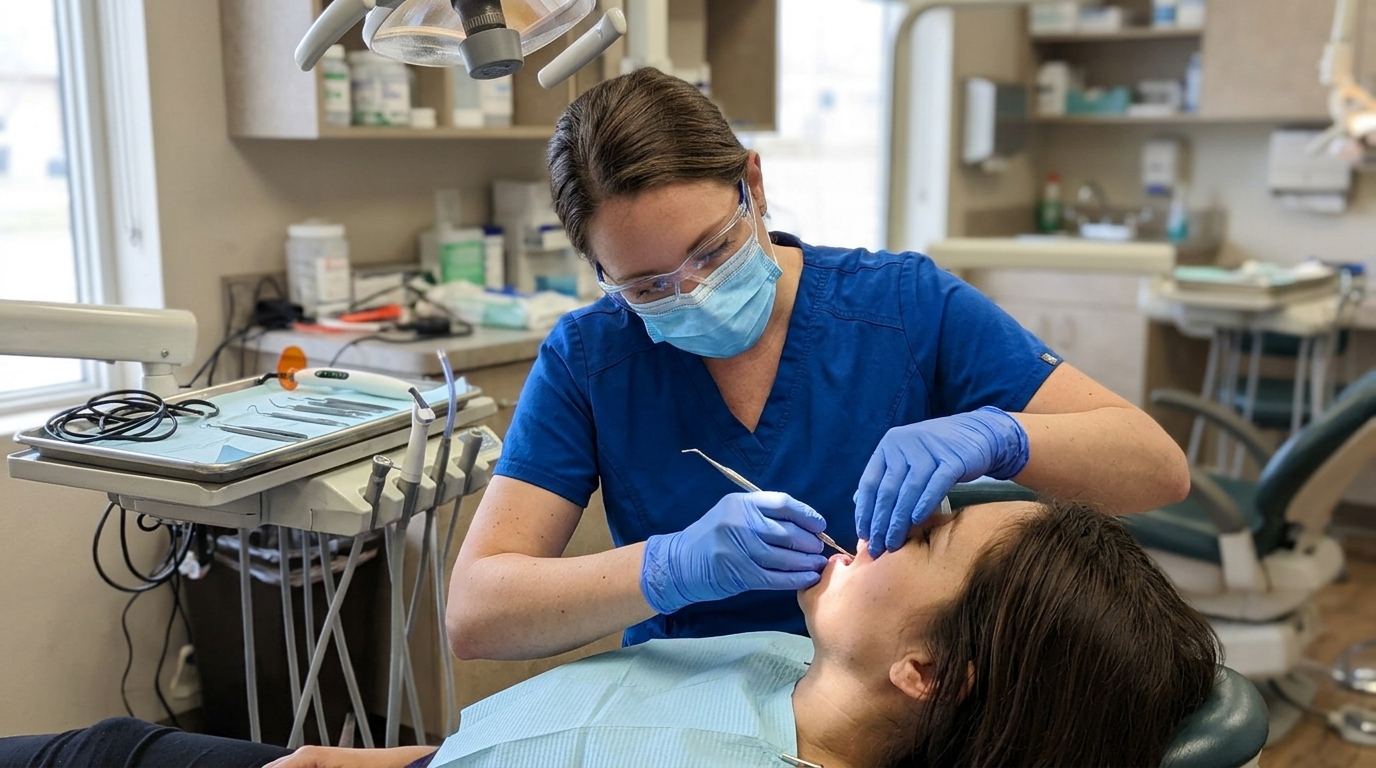
Most of your day is chairside with one patient at a time, working to an appointment book of fixed slots. Typical duties include removing tartar, stains and plaque; applying sealants and fluorides; taking and developing dental x-rays; assessing a patient's oral health and reporting findings to the dentist; documenting care and treatment plans; and teaching brushing and flossing technique (U.S. Bureau of Labor Statistics, 2026-10-29).
The toolkit is wider than most patients realise. Hygienists use hand, power and ultrasonic instruments, sometimes lasers, an air-polishing device that sprays air, water and baking soda, and x-ray machines (U.S. Bureau of Labor Statistics, 2026-10-29). Add digital charting and practice-management software, plus the sterilisation and infection-control routine that bookends every appointment.
Offices of dentists employ the largest share of hygienists (U.S. Bureau of Labor Statistics, 2026-10-29). You will also find roles in corporate and group clinics, periodontal and orthodontic practices, community and public health clinics, school prevention programmes, hospital dental departments, prison and military dental services, and dental schools. In a few U.S. states, hygienists with additional training — sometimes called dental therapists — provide some restorative services, such as extracting primary teeth and placing temporary crowns (U.S. Bureau of Labor Statistics, 2026-10-29).
Hours are often not a standard full-time week. Many dental hygienists work part time, and dentists may hire a hygienist for only a few days a week, so some work for more than one dentist (U.S. Bureau of Labor Statistics, 2026-10-29). Expect early starts, and evening or Saturday clinics in practices that run them.
Physically the work is precise, static and repetitive: long stretches in a fixed posture, fine hand control, gloves and mask all day, exposure to aerosols and sharps, and a real risk of neck, back and wrist strain. Socially, you carry the appointment — settling anxious patients and explaining findings plainly, for the tenth time that day.
Skills and Qualifications Employers Require
Required by the regulator, and different in every jurisdiction:
- A licence or registration to practise. In the United States, all states require dental hygienists to be licensed, and requirements vary by state (U.S. Bureau of Labor Statistics, 2026-10-29). Other countries register hygienists through a national dental regulator — confirm the body before you commit to a course.
- A degree from an accredited dental hygiene programme. In most U.S. states, licensure requires an accredited degree plus passing written and clinical examinations (U.S. Bureau of Labor Statistics, 2026-10-29). Verify a programme's accreditation with the licensing authority before paying a deposit.
- Continuing education. Hygienists must complete continuing education requirements to maintain licensure (U.S. Bureau of Labor Statistics, 2026-10-29); hours and cycles vary by state and country.
- Permission to take radiographs. Taking and developing dental x-rays is a core duty (U.S. Bureau of Labor Statistics, 2026-10-29), and the right to do it is usually tied to specific training under local radiation rules.
- Extra training for expanded scope, where a few U.S. states allow limited restorative work (U.S. Bureau of Labor Statistics, 2026-10-29).
Required or preferred by employers:
- Cardiopulmonary resuscitation (CPR) certification — many jobs require it (U.S. Bureau of Labor Statistics, 2026-10-29).
- A criminal record or background check and up-to-date immunisation records, standard in clinical and school settings.
- Education level: the occupation sits in Job Zone Three, 'Medium Preparation Needed', covering work that typically needs vocational school training, related experience or an associate's degree (O*NET OnLine, U.S. Department of Labor, 2026). Public health and teaching roles often prefer a bachelor's degree.
- Practical skills: accurate ultrasonic and hand scaling to time, confident radiographic technique, clean charting in the practice's software, infection control, and comfort with anxious, elderly and paediatric patients.
- A second language, genuinely preferred in many community clinics.
Steps to Become a Dental Hygienist
- Read your regulator's rules first. Identify the licensing body for the country, state or province where you want to work, since requirements vary by state in the United States (U.S. Bureau of Labor Statistics, 2026-10-29).
- Complete the prerequisites. Most programmes expect secondary school with science subjects, and many require college-level biology, chemistry and anatomy.
- Apply to an accredited dental hygiene programme that the regulator recognises for licensure — usually at a community college, technical institute or university dental school. Entry is competitive and may involve an interview, admissions test or shadowing log.
- Complete the supervised clinical hours, treating real patients in a teaching clinic, where scaling, radiography and patient management are assessed.
- Obtain CPR certification and any radiography permission your jurisdiction requires, as many jobs require CPR anyway (U.S. Bureau of Labor Statistics, 2026-10-29).
- Sit the written and clinical examinations set or accepted by your regulator, required in most U.S. states alongside the accredited degree (U.S. Bureau of Labor Statistics, 2026-10-29).
- Apply for the licence or registration, with fees, identity documents, a background check where required and proof of immunisations.
- Apply directly to practices. Hiring here is mostly direct: practices advertise on association boards and general job sites, use temp and locum agencies, and recruit from clinical placements by word of mouth. Public health and school services may run through a government or civil-service portal.
- Log continuing education from year one, since it is required to maintain licensure (U.S. Bureau of Labor Statistics, 2026-10-29).
Where to Find Dental Hygienist Openings
| Source | Type | Best for |
|---|---|---|
| American Dental Hygienists' Association, American Dental Association and National Dental Hygienists Association, listed by ONET as the national associations for this occupation (ONET OnLine, U.S. Department of Labor, 2026) | Trade/professional association | U.S. clinic vacancies aimed at licensed hygienists, plus state-component contacts |
| Your country's national or regional dental association and local branches | Trade/professional association | Practice vacancies and locum lists that never reach general boards |
| State and local job-opening search tools listed by ONET for this occupation (ONET OnLine, U.S. Department of Labor, 2026) | Government portal | Public health clinics, school dental services, prison and military roles |
| apprenticeship.gov, listed by ONET as an apprenticeship resource for this occupation (ONET OnLine, U.S. Department of Labor, 2026) | Government portal | Earn-while-you-train routes where your state offers them |
| Career pages of dental group practices, community health centres, hospital dental departments and dental schools | Direct employer career page | Full-time, benefit-bearing posts; multi-site groups advertise here first |
| Dental staffing and temp-shift agencies | Staffing agency | Day rates, sickness cover, trialling a practice before committing |
| General national job boards used in your country | National job board | Volume of private practice listings; set alerts for your city |
Use at least two: an association board for clinically specific roles and a general national board for coverage. Add an agency if you want to build a week from several part-time diaries, which is common in this occupation (U.S. Bureau of Labor Statistics, 2026-10-29).
Frequently Asked Questions
How is dental hygienist pay usually structured?
Practices pay an hourly rate, a daily or sessional rate for the days you cover, or a base rate plus a production element tied to treatment delivered. If you split a week between two dentists, neither may provide paid leave or insurance. For the United States, the Bureau of Labor Statistics publishes a median annual wage for the occupation in its Occupational Outlook Handbook (U.S. Bureau of Labor Statistics, 2026-10-29); elsewhere, check your national statistics agency or dental association. Pay varies by employer, setting and region, so confirm the currency, the rate and whether it is hourly or annual before accepting.
Can I get in without clinical experience?
You cannot practise before you are licensed or registered, so there is no shortcut past the accredited programme and the examinations. What stands in for paid experience is your supervised training: the patients you treated in the teaching clinic, your radiography record and references from clinical instructors. Many hygienists are hired by a practice that hosted their placement, so treat placements as a long interview.
How hard is the work physically?
Harder than it looks from the waiting room. You work seated in a fixed posture for long stretches using hand, power and ultrasonic instruments and an air-polishing device that sprays air, water and baking soda (U.S. Bureau of Labor Statistics, 2026-10-29), all demanding sustained grip and fine control. Neck, shoulder and wrist strain is the main career risk, which is why loupes, saddle stools, sharp instruments and scheduled breaks matter from week one.
How quickly might I find an opening?
That depends on your area and how far you will travel. In the United States, the Bureau of Labor Statistics projects annual openings over the 2025-35 decade arising mostly from workers transferring to other occupations or leaving the labour force (U.S. Bureau of Labor Statistics, 2026-10-29); check current figures in the Occupational Outlook Handbook. In practice, applicants open to two part-time diaries, or registered with a dental staffing agency, tend to start sooner than those holding out for one full-time post nearby.
What progression exists after a few years chairside?
Common routes include working with periodontal or paediatric practices, moving into public health and school prevention programmes, teaching on a dental hygiene programme, or education roles with dental product companies. In a few U.S. states, additional training allows hygienists — sometimes called dental therapists — to provide limited restorative services such as extracting primary teeth and placing temporary crowns (U.S. Bureau of Labor Statistics, 2026-10-29). Practice management is another step, as is independent hygiene practice where local rules allow it.
Sources
- U.S. Bureau of Labor Statistics — Dental Hygienists : Occupational Outlook Handbook (2026-10-29)
- O*NET OnLine (U.S. Department of Labor) — Summary Report for: 29-1292.00 - Dental Hygienists (2026)