HVAC technicians install, service and repair heating, ventilation, air conditioning and refrigeration equipment in homes, schools, hospitals and commercial buildings. Most people enter through a certificate or associate's programme at a technical school or community college, or through a paid apprenticeship, then qualify to handle refrigerants under their country's environmental rules.
In the United States that credential is EPA Section 608 Technician Certification, and some states and localities add their own licence. Elsewhere the training route looks similar but the certifying body differs, so check your national regulator before you enrol in anything.
What an HVAC Technician Does Day to Day
Your day runs on dispatched service calls or scheduled install work. On a service call you discuss the heating or cooling malfunction with the occupant or building manager to isolate the problem, then verify with them that the repair corrected it — a listed task for the occupation (O*NET OnLine, U.S. Department of Labor, undated).
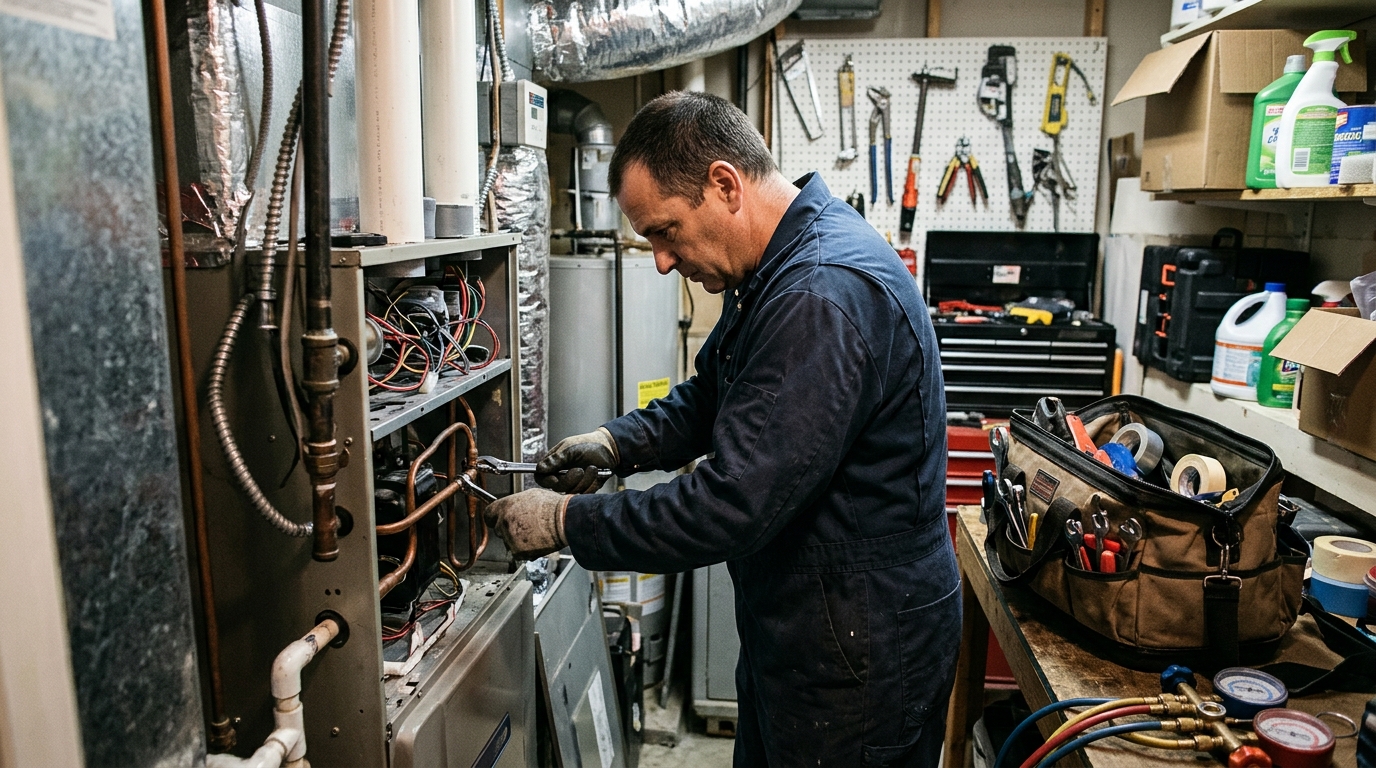
Diagnosis mixes electrical and mechanical work: testing circuits and components for continuity using electrical test equipment (O*NET OnLine, U.S. Department of Labor, undated), reading manifold gauges, recovering and recharging refrigerant, changing contactors, capacitors and motors, brazing line sets and pulling a vacuum before commissioning. Install days mean moving equipment, cutting and hanging duct, running condensate drains and wiring thermostats or controls.
These workers install and repair systems in homes, schools, hospitals and other buildings, and may work in cramped spaces, outdoors or in extreme temperatures; most work full time with schedules that may vary (U.S. Bureau of Labor Statistics, 2025). In practice that means seasonal overtime when heating fails in winter and cooling fails in summer, plus on-call rotations at many employers.
Typical employers are residential and commercial HVAC/R contracting firms, mechanical contractors on construction projects, in-house facilities departments at hospitals, universities, school districts and local government, supermarket and cold-storage refrigeration specialists, and the service arms of equipment manufacturers. You usually drive a stocked van between sites, and technicians may need a driver's licence to travel to jobsites (U.S. Bureau of Labor Statistics, 2025).
Skills and Qualifications Employers Require
Required by law or a regulator:
- EPA Section 608 Technician Certification (United States). EPA regulations under Section 608 of the Clean Air Act require technicians who maintain, service, repair or dispose of equipment that could release ozone-depleting refrigerants to be certified (U.S. Environmental Protection Agency, undated). You must pass an EPA-approved test administered by an EPA-approved certifying organisation, specific to the equipment type you will work on, and the credential does not expire (U.S. Environmental Protection Agency, undated).
- A state or local HVAC licence, where one applies. Some states and localities require technicians to be licensed, and requirements by state licensing board are published on CareerOneStop (U.S. Bureau of Labor Statistics, 2025).
- An equivalent refrigerant handling credential outside the US, issued by that country's environmental or trade regulator. Do not assume a US credential transfers.
- A driver's licence, since technicians may need one to travel to jobsites (U.S. Bureau of Labor Statistics, 2025).
Usually required or preferred by employers:
- A certificate or associate's degree in heating, air conditioning and refrigeration. Typical entry-level education is a postsecondary nondegree award, and programmes at technical and trade schools or community colleges generally last from 6 months to 2 years (U.S. Bureau of Labor Statistics, 2025).
- An apprenticeship, which usually lasts several years and combines paid on-the-job training with technical instruction each year covering safety practices, blueprint reading, and heating and cooling systems (U.S. Bureau of Labor Statistics, 2025).
- Hands-on experience. The occupation sits in ONET's Job Zone Three, Medium Preparation Needed, where workers usually need one or two years of training involving on-the-job experience and informal training with experienced workers (ONET OnLine, U.S. Department of Labor, undated).
- NATE certification (United States), which requires passing both the Core exam and a specialty exam (North American Technician Excellence, undated). Contractors generally treat it as a preference or pay step, not a legal requirement.
- A clean background check and drug screen, standard where you work unsupervised in occupied homes, schools or hospitals.
Qualities that matter on the job: customer-service skills, being detail oriented, math skills, mechanical skills, physical stamina and physical strength (U.S. Bureau of Labor Statistics, 2025).
Steps to Become an HVAC Technician
These steps follow the stages of the process rather than one country's system. Confirm exam and licence names with the regulator where you plan to work before paying for anything.
- Finish secondary school with maths and physics if you can. Load calculations, pressure–temperature relationships and electrical theory draw on them, and math skills are listed as an important quality for the occupation (U.S. Bureau of Labor Statistics, 2025).
- Choose a training route. Either enrol in an HVACR certificate or associate's programme at a technical or trade school or community college — generally 6 months to 2 years (U.S. Bureau of Labor Statistics, 2025) — or apply to an apprenticeship, which usually lasts several years and pays you while you train (U.S. Bureau of Labor Statistics, 2025).
- Apply to apprenticeships through the right channel. Intake is run by union joint apprenticeship committees, individual contractors and government apprenticeship registries rather than general job boards, and often opens once or twice a year with an aptitude test and interview.
- Sit the refrigerant handling exam. In the US, pass the EPA-approved Section 608 test with an EPA-approved certifying organisation for the equipment type you will work on (U.S. Environmental Protection Agency, undated). It is typically included as part of completing a postsecondary HVACR programme (U.S. Bureau of Labor Statistics, 2025).
- Check licensing before you job-hunt. CareerOneStop lists state licensing board requirements (U.S. Bureau of Labor Statistics, 2025); note any supervised experience hours, which must usually be logged before you can sit a licence exam.
- Get a driver's licence and a clean record check, since service work is van-based (U.S. Bureau of Labor Statistics, 2025).
- Take a helper, installer or apprentice role and build hours, expecting one or two years of on-the-job experience alongside experienced workers before you run calls alone (O*NET OnLine, U.S. Department of Labor, undated).
- Add specialty credentials once working — in the US commonly the NATE Core exam plus a specialty exam (North American Technician Excellence, undated), or manufacturer training on the lines your employer installs.
Where to Find HVAC Technician Openings
Because the title names no country, most entries below are source categories; named sources are identified by the country they serve.
| Source | Type | Best for |
|---|---|---|
| CareerOneStop (U.S. Department of Labor) | Government portal | US readers checking state licensing board requirements and finding training and apprenticeship programmes (U.S. Bureau of Labor Statistics, 2025) |
| Your country's public employment service or apprenticeship registry | Government portal | Registered apprenticeships, funded training places and public-sector maintenance vacancies |
| Large national job boards and aggregators | National job board | Volume of contractor service and install roles; set alerts for "HVAC", "refrigeration" and "service technician" |
| HVAC/R contracting firms' own career pages | Direct employer career page | Apprentice and helper intakes that never reach job boards; apply directly and follow up by phone |
| Facilities pages at hospitals, universities, school districts and councils | Direct employer career page | In-house maintenance posts with steadier hours, often filled by formal or civil-service application |
| Trade and professional association job boards and member directories | Trade/professional association | Listing every contractor in your area to approach |
| Union local hiring halls and joint apprenticeship committees | Union hiring hall | Paid apprenticeship intakes and dispatch to commercial projects |
| Skilled-trades staffing agencies | Staffing agency | Seasonal install crews; a route in if you hold certification but little experience |
For scale in the US market, about 40,600 openings for heating, air conditioning and refrigeration mechanics and installers are projected each year on average over the decade, with employment projected to grow 11% from 2025 to 2035 (U.S. Bureau of Labor Statistics, 2025). For an applicant, that usually means approaching several local contractors at once rather than waiting on one vacancy — not a guarantee of an offer, since licensing and background requirements still gate the role.
Frequently Asked Questions
How is HVAC pay usually structured?
Most service and install technicians are paid an hourly rate, with overtime during heating and cooling peaks and extra pay for on-call or emergency callouts. Some residential firms add commission on equipment sales and maintenance agreements, and apprentices are paid on a scale that steps up with each training year. Rates vary by employer, sector and region — in the US, check current wage data for this occupation in the Bureau of Labor Statistics Occupational Outlook Handbook, or your own national statistics agency elsewhere.
Can I get hired without any experience?
Not as a lead technician, because refrigerant handling is regulated and some areas license the trade. The realistic entry points are an apprenticeship with paid on-the-job training plus technical instruction each year (U.S. Bureau of Labor Statistics, 2025), or a helper or installer's assistant role while you complete a certificate programme. Both mean working under someone certified until you hold your own credential.
How physically demanding is the work?
Demanding enough to rule the job out for some people. You may work in cramped spaces, outdoors, or in extreme temperatures (U.S. Bureau of Labor Statistics, 2025), carrying equipment up ladders and into attics, and physical stamina and physical strength are listed among the important qualities for the occupation (U.S. Bureau of Labor Statistics, 2025). Plant-room and controls work tends to be less punishing than residential change-outs.
Do I have to retake the refrigerant exam?
In the United States, Section 608 Technician Certification credentials do not expire (U.S. Environmental Protection Agency, undated). A state or local HVAC licence is separate and may carry its own renewal and continuing-education conditions, and other countries set their own rules — check with the issuing body.
Where can the job lead after a few years?
Common moves are into commercial refrigeration or building controls, service manager or dispatcher roles, estimating and project management with a mechanical contractor, manufacturer field support or technical training, or running your own contracting business — which in licensed jurisdictions usually requires a contractor licence rather than just a technician credential.
Sources
- U.S. Bureau of Labor Statistics — Heating, Air Conditioning, and Refrigeration Mechanics and Installers : Occupational Outlook Handbook (2025)
- U.S. Environmental Protection Agency — Section 608 Technician Certification