Most phlebotomy openings sit with hospitals and with medical and diagnostic laboratories, which the U.S. Bureau of Labor Statistics (2025) names among the largest employers of phlebotomists. Depending on where you live, you apply directly through a hospital system's careers site, through a government civil-service portal, through a staffing agency for per-diem shifts, or through a registered apprenticeship.
Which route fits depends on your credentials and your location: states may require accredited training, a licence or certification (U.S. Bureau of Labor Statistics, 2025), and outside the United States the regulator and the job portals are different again.
Who Hires Phlebotomists and Where
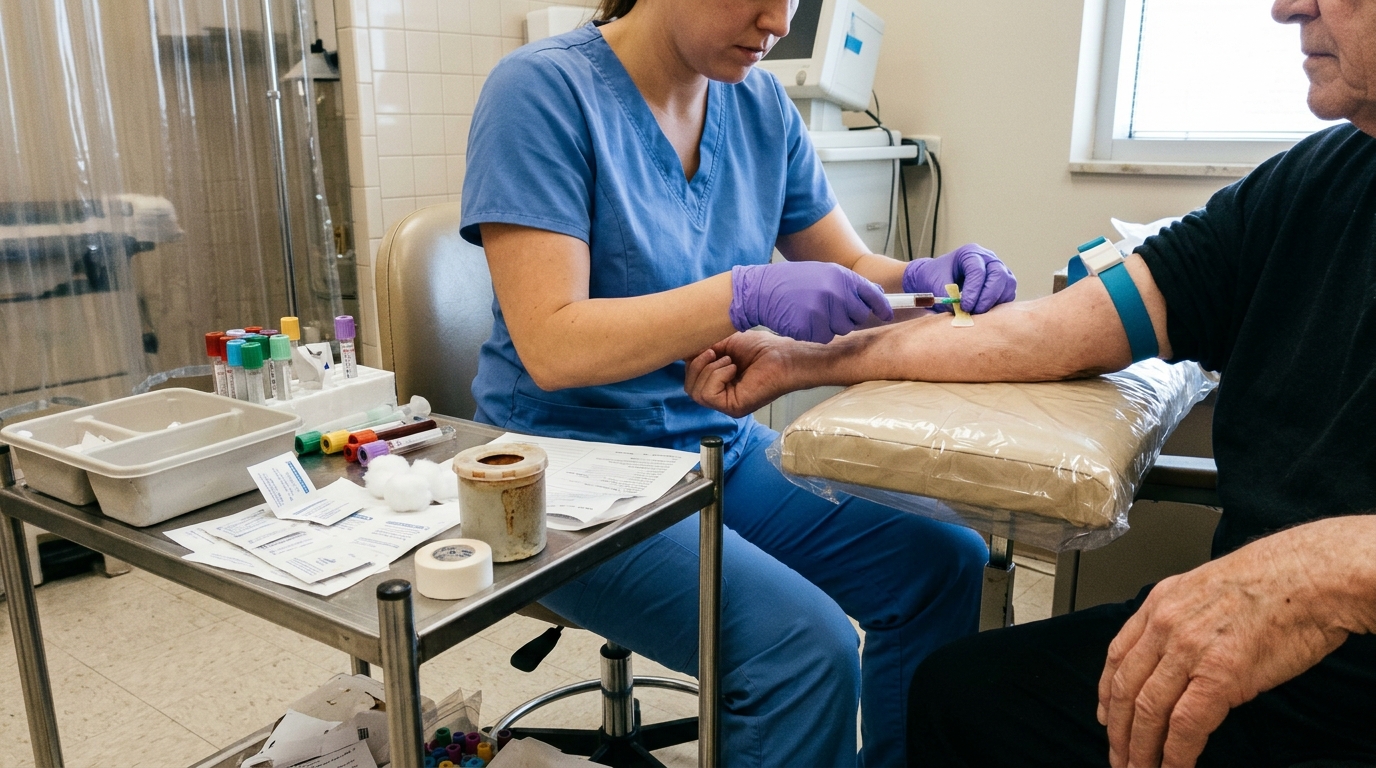
Hospitals — state, local and private — and medical and diagnostic laboratories are among the largest employers of phlebotomists (U.S. Bureau of Labor Statistics, 2025). Within those, draws happen on inpatient units, in emergency departments, at outpatient draw stations and in central specimen processing.
The other employer categories are blood and plasma donor centres, physician offices and clinics, long-term care and dialysis facilities, mobile draw and insurance-exam services, and healthcare staffing agencies filling per-diem and travel shifts. Public agencies hire directly too: Ventura County's government job board lists a tiered classification titled 'Certified Phlebotomy Technician I/II/III' (County of Ventura), and New York City's official civil-service portal lists a 'Phlebotomist' position for all boroughs (City of New York).
Some systems run their own entry routes rather than hiring only experienced staff. MultiCare Health System advertises a Certified Phlebotomist Training Program, and St. Luke's University Health Network lists paid trainee and apprentice programs on its careers site.
Hiring is steady rather than seasonal, because labs run continuously. Most phlebotomists work full time, and those in hospitals and labs may work nights, weekends and holidays (U.S. Bureau of Labor Statistics, 2025), so off-shift vacancies post most often.
Best Places to Search for Phlebotomist Openings
- Hospital and health-system careers pages. Trainee routes appear here that aggregators miss — MultiCare Health System's Certified Phlebotomist Training Program, and the paid trainee and apprentice programs listed by St. Luke's University Health Network. Check two or three systems within your travel radius.
- Apprenticeship.gov (U.S. Department of Labor). 'Phlebotomist' is an example apprenticeship title vetted by industry and approved for a Registered Apprenticeship Program, searchable through this portal (O*NET OnLine). Useful if you want paid on-the-job training rather than paying for a course first.
- Government civil-service portals. New York City's official job portal carries a 'Phlebotomist' listing covering all boroughs, and GovernmentJobs.com hosts county postings such as Ventura County's 'Certified Phlebotomy Technician I/II/III'. Both state the exact classification and certificate in the posting.
- Certifying-body websites. Checking NHA CPT, ASCP PBT, AMT RPT and NCCT (Phlebotomy.school) tells you which credential acronyms local postings ask for, so you can search by the right keyword.
- General aggregators such as Indeed or LinkedIn. Filter by shift and certification keyword, then cross-check against the employer's own careers page, which is usually more current.
Outside the United States, start with your national or regional health service recruitment portal and your country's pathology or medical laboratory regulator, which will name the local qualification.
How to Apply for a Phlebotomist Role
- Check your jurisdiction's rules first. States may require an accredited training program, a licence or certification, or other conditions; contact your state licensing agency for specifics (U.S. Bureau of Labor Statistics, 2025). Elsewhere, check the equivalent health regulator before paying for anything.
- Complete the training. Typical entry-level education is a postsecondary nondegree award, and certificate programs at community colleges, vocational schools or technical schools usually take less than one year (U.S. Bureau of Labor Statistics, 2025).
- Sit the certification exam. Requirements vary by organisation but may include education and clinical experience, an exam and a practical component such as drawing blood (U.S. Bureau of Labor Statistics, 2025). Commonly compared credentials are NHA CPT, ASCP PBT, AMT RPT and NCCT (Phlebotomy.school).
- Add Basic Life Support certification, which phlebotomists may also need, and a driver's licence if you will transport samples (U.S. Bureau of Labor Statistics, 2025).
- Pick the channel. Private hospitals and labs take direct online applications. County and city roles require a civil-service application against a named classification and may involve an eligibility list. Per-diem and travel work goes through staffing agencies, who screen you once and then offer shifts. Apprenticeships are applied for through the sponsoring employer.
- Expect contingent-offer screening: background check, drug screen, immunisation and TB records, and often an observed draw.
- Prepare duty-specific answers on order of draw, bedside labelling, a patient with difficult veins or who faints mid-draw, a haemolysed or short-draw recollection, and how you confirm patient identity.
Application Checklist Before You Submit
| Item | What to include |
|---|---|
| Training certificate | Proof of completing your phlebotomy certificate program, with clinical hours stated |
| Draw log | Documented venipunctures and capillary sticks, signed by your clinical instructor |
| Certification card | NHA CPT, ASCP PBT, AMT RPT or NCCT, with number and expiry date (Phlebotomy.school) |
| State licence | Where your state requires one — confirm with the state licensing agency (U.S. Bureau of Labor Statistics, 2025) |
| Basic Life Support card | Current, with issue date (U.S. Bureau of Labor Statistics, 2025) |
| Driver's licence | Required for roles involving sample transport (U.S. Bureau of Labor Statistics, 2025) |
| Health records | Immunisation history and TB screening, as the employer requests |
| References | A clinical instructor or lab supervisor who has watched you draw |
| Availability | Say plainly which nights, weekends and holidays you can cover |
For civil-service applications, answer the supplemental questions against the exact classification wording in the posting; screening is usually against those stated criteria.
Frequently Asked Questions
Can I apply before I am certified?
Sometimes. MultiCare Health System advertises a Certified Phlebotomist Training Program, and St. Luke's lists paid trainee and apprentice programs. But states may require an accredited training program, a licence or certification before you draw (U.S. Bureau of Labor Statistics, 2025), so contact your state licensing agency first. Public-sector classifications such as Ventura County's 'Certified Phlebotomy Technician I/II/III' name the certificate in the title.
How long does it take to become employable?
Certificate programs at community colleges, vocational schools or technical schools usually take less than one year (U.S. Bureau of Labor Statistics, 2025). O*NET places phlebotomists in Job Zone Three, where employees usually need one or two years of training combining on-the-job experience and informal training with experienced workers, and previous work-related skill is expected. Plan to keep building after your first role.
Does experience substitute for certification?
It depends on the employer and the state. Where a state requires an accredited program or licence, experience alone will not satisfy it (U.S. Bureau of Labor Statistics, 2025). Where it does not, some hospitals and labs accept documented draw experience, but many postings still name a credential such as NHA CPT, ASCP PBT, AMT RPT or NCCT (Phlebotomy.school). Read each posting's minimum qualifications.
Sources
- U.S. Bureau of Labor Statistics — Phlebotomists : Occupational Outlook Handbook (2025)
- O*NET OnLine (U.S. Department of Labor) — 31-9097.00 - Phlebotomists