Medical assistants handle both the clinical and the clerical side of outpatient care — taking vital signs, prepping patients and rooms, and keeping records and schedules straight. In the United States, typical entry-level education is a postsecondary nondegree award, with no prior work experience in a related occupation required (U.S. Bureau of Labor Statistics, 2025), usually a certificate or associate's degree taking about one or two years and including a supervised practicum (U.S. Bureau of Labor Statistics, 2025).
What you must hold to practise depends on where you work. Some U.S. states require graduation from an accredited program, licensure or certification; most do not require certification, though employers may prefer or require it, and some require Basic Life Support (BLS) certification (U.S. Bureau of Labor Statistics, 2025). Outside the U.S. the title differs — in Malaysia the equivalent role is the Assistant Medical Officer (Wikipedia, undated).
What a Medical Assistant Does Day to Day
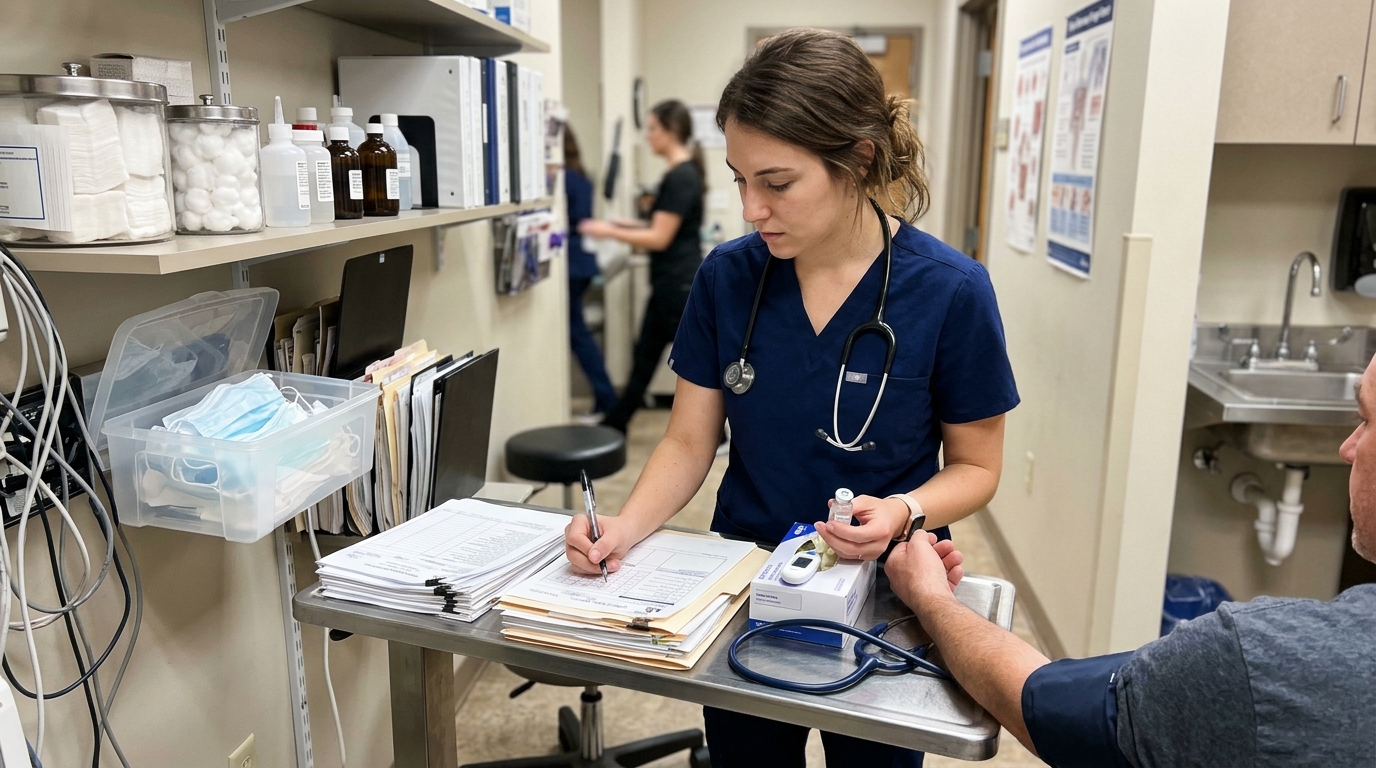
Your day splits between the clinical side and the front office, and in a small practice you often do both in the same hour. Typical duties include interviewing patients and recording medical history, measuring vital signs such as blood pressure and weight, helping physicians with patient examinations, giving injections or medications as permitted by state law, scheduling appointments, collecting and preparing laboratory specimens, entering patient information into medical records, and maintaining inventory of medical and office supplies (U.S. Bureau of Labor Statistics, 2025).
In practice that means rooming patients on a timed schedule, working an electronic health record all day, handling blood pressure cuffs, thermometers, pulse oximeters, scales and specimen tubes, stocking or autoclaving instruments, and chasing referrals and prior-authorisation paperwork between patients. What you may do clinically — injections especially — is set by state law in the United States and by the equivalent regulator elsewhere, so two assistants in neighbouring jurisdictions can have different scopes.
Employers are overwhelmingly outpatient: offices of physicians 56%, hospitals (state, local and private) 17%, outpatient care centres 10%, and offices of other health practitioners 8% (U.S. Bureau of Labor Statistics, 2025). Think family medicine and specialty clinics, urgent care, dialysis and surgical centres, optometry and chiropractic practices, and hospital outpatient departments.
Most medical assistants work full time, and some work evening, weekend or holiday shifts in facilities open around the clock (U.S. Bureau of Labor Statistics, 2025). The work is on your feet, with lifting and steadying of patients, exposure to bodily fluids and sharps, and constant interruption.
Be clear on one distinction: both roles work under physicians, but physician assistants practise medicine and can prescribe medication under a physician's supervision, while medical assistants do not (U.S. Bureau of Labor Statistics, 2025).
Skills and Qualifications Employers Require
Required by law or regulator (United States, varies by state):
- Graduation from an accredited medical assisting program, licensure, certification or other prerequisites — some states require these, and most states do not require certification (U.S. Bureau of Labor Statistics, 2025). Check your state board or health department before enrolling.
- Authorisation to perform specific clinical tasks such as injections or medication administration, as permitted by state law (U.S. Bureau of Labor Statistics, 2025).
- Outside the U.S., the credential is set nationally; in Malaysia the comparable role is the Assistant Medical Officer (Wikipedia, undated).
Commonly required or preferred by employers:
- A medical assistant certificate or associate's degree from a community college, vocational school, technical school or university, including a practicum or internship (U.S. Bureau of Labor Statistics, 2025).
- Basic Life Support (BLS) certification — some employers require it (U.S. Bureau of Labor Statistics, 2025).
- A national certification: the CMA (AAMA) Certification Exam from the American Association of Medical Assistants, the RMA from American Medical Technologists, or an exam from the National Healthcareer Association, which develops certification exams for allied health professions including medical assistant, phlebotomy, EKG, and medical billing and coding (Wikipedia, undated).
- Pre-employment background and health screening, which most clinical employers run before you start.
Skills hiring managers test for: accurate vital signs and documentation under time pressure; electronic health record entry, scheduling and inventory tracking (U.S. Bureau of Labor Statistics, 2025); error-free specimen collection and labelling; and plain-language communication with frightened or angry patients. If you are still at school, biology and chemistry are the recommended preparation (U.S. Bureau of Labor Statistics, 2025).
Steps to Become a Medical Assistant
- Confirm the rules where you intend to work. In the United States that means your state: some require graduation from an accredited program, licensure or certification, and information on certifications is available from CareerOneStop (U.S. Bureau of Labor Statistics, 2025). Elsewhere, check your national health regulator, since the job title itself may differ.
- Finish secondary school with science subjects — biology and chemistry are the recommended classes (U.S. Bureau of Labor Statistics, 2025).
- Enrol in a postsecondary medical assisting program, taking about one or two years (U.S. Bureau of Labor Statistics, 2025). If you plan to sit a U.S. certification exam, choose a program accredited by CAAHEP or ABHES, since CMA (AAMA) eligibility generally requires being a current student or graduate of such a program, or meeting the Alternative Pathway (American Association of Medical Assistants, undated).
- Complete the supervised practicum or externship built into the program (U.S. Bureau of Labor Statistics, 2025), and treat it as an extended interview — clinics often hire their own externs.
- If you cannot attend a program, look for an employer offering on-the-job training or an apprenticeship, which may take several months depending on the facility (U.S. Bureau of Labor Statistics, 2025).
- Obtain CPR/BLS certification, including in-person demonstration of proficiency, which is required documentation for some certification routes and by some employers (American Medical Technologists, undated; U.S. Bureau of Labor Statistics, 2025).
- Register for and pass a certification exam if you want one. CMA (AAMA) candidates can register once classroom coursework excluding the practicum is finished, and recent graduates are eligible if they apply within 12 months of graduation (American Association of Medical Assistants, undated). The RMA Education Route requires graduation within the past four years, or scheduled graduation, from an accredited program with at least 720 hours of instruction including at least 160 hours of externship; the Work Experience Route requires at least three years of employment within the past seven covering clinical and administrative duties, with three years at 36 hours per week described as equivalent to 5,616 hours. All RMA applicants must pass the AMT examination for RMA (American Medical Technologists, undated).
- Clear employer screening — background check, immunisation records, health clearance — then apply directly to clinics, hospital systems and outpatient centres.
Where to Find Medical Assistant Openings
No country is assumed here, so these are source categories with bodies named where they exist. Check at least two before deciding where to focus.
| Source name | Type | Best for |
|---|---|---|
| Hospital and health-system career pages | Direct employer career page | Outpatient departments and clinic networks; hospitals employed 17% of medical assistants (U.S. Bureau of Labor Statistics, 2025) |
| Physician practice and group clinic websites | Direct employer career page | The largest employer group at 56% (U.S. Bureau of Labor Statistics, 2025); small practices often post only on their own site |
| AAMA, AMT and NHA in the United States; the equivalent allied health body elsewhere | Trade/professional association | Roles where certification is preferred, plus exam and renewal rules |
| CareerOneStop (United States), or your national labour-ministry employment portal | Government portal | Certification requirements by state (U.S. Bureau of Labor Statistics, 2025) and publicly funded clinic vacancies |
| Healthcare staffing and temporary-placement agencies | Staffing agency | Leave cover and float pools; first clinical experience after a certificate |
| Your program's career service and externship partners | Training provider placement | Converting a practicum into an offer at the site where you trained |
Frequently Asked Questions
What do medical assistants earn?
Pay is usually an hourly wage, sometimes with shift differentials for evenings and weekends. In the United States the median annual wage was stated as $45,690 and the median hourly wage as $21.97 (U.S. Bureau of Labor Statistics, 2025) — median means half earned more and half less, and actual pay varies by employer, specialty and region. Check the current figure with your own country's statistics agency or government careers portal.
Can I start without completing a training program?
Sometimes. Medical assistants without postsecondary education may learn skills through on-the-job training or an apprenticeship, taking several months depending on the facility (U.S. Bureau of Labor Statistics, 2025). But some states require accredited-program graduation, licensure or certification to practise (U.S. Bureau of Labor Statistics, 2025), and that route closes off most exams — CMA (AAMA) eligibility generally runs through a CAAHEP- or ABHES-accredited program (American Association of Medical Assistants, undated).
How long will it take to find an opening?
That depends on clinic density where you live, not national totals, but the scale gives context: medical assistants held about 833,900 jobs in 2025, employment is projected to grow 13 percent from 2025 to 2035, and about 109,700 openings are projected each year on average over the decade (U.S. Bureau of Labor Statistics, 2025). Count the physician offices, urgent care centres and outpatient clinics within commuting distance — most hire by direct application.
What are the hours and physical demands?
Most medical assistants work full time, and some work evening, weekend or holiday shifts in facilities open around the clock (U.S. Bureau of Labor Statistics, 2025). Expect to stand and walk most of the shift, help patients on and off exam tables, handle sharps and specimens, and switch between clinical tasks and the phone or record system repeatedly.
Where can certification take me next?
Certification bodies cover neighbouring allied health roles — the National Healthcareer Association publishes exams for medical assistant, phlebotomy, EKG, and medical billing and coding (Wikipedia, undated) — so many people move sideways into one of those, or into lead medical assistant, clinic supervisor or practice administration. Others use the clinical hours and science coursework as a base for nursing programs, whose entry rules are set by the relevant licensing board.
Sources
- U.S. Bureau of Labor Statistics — Medical Assistants : Occupational Outlook Handbook (2025)
- American Association of Medical Assistants (AAMA) — Eligibility - CMA (AAMA) Certification Exam