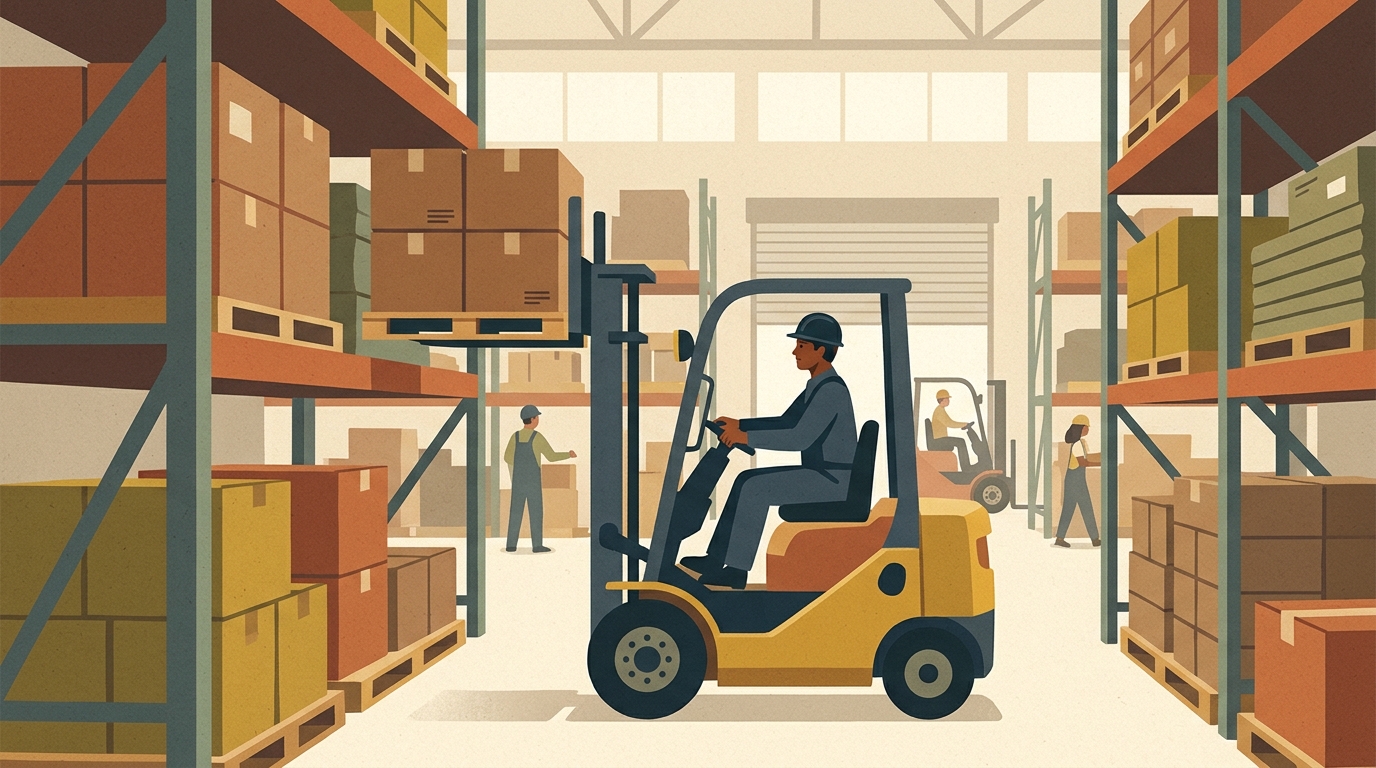
A forklift operator interview is short on small talk and heavy on safety, equipment knowledge and a practical test on the machine you would actually drive. Expect a screening call, an interview with a warehouse or yard supervisor, a licence or certification check, and a hands-on assessment in the aisles or on the dock.
This guide is country-neutral, because training and licensing rules differ sharply by country and sometimes by state or province. Where a rule is named below, the country it applies to is named with it.
What the Forklift Operator Interview Process Looks Like
This guide is country-neutral. The work is similar everywhere — ONET defines the occupation as operating industrial trucks or tractors equipped to move materials around a warehouse, storage yard, factory, construction site, or similar location (ONET OnLine, U.S. Department of Labor/Employment and Training Administration, 2026) — but the paperwork you must show differs by country.
Screening call. Often from a staffing agency rather than the site, especially in third-party logistics and seasonal work. Expect questions on truck types driven, shift availability, and whether your training or licence is current.
Supervisor interview. Usually 20 to 40 minutes, on site, sometimes standing on the dock. The questions are operational: inspections, load handling, near misses, scanners and inventory systems, working around pedestrians.
Practical assessment. Many employers put you on the truck: a pre-start check out loud, a route with a loaded pallet, a stack to a set height, a reverse into a bay. Some sites add a written safety quiz.
Credential check. What is checked depends on the country. In the United States, OSHA's powered industrial truck standard (29 CFR 1910.178(l)) requires the employer to provide operator training covering truck-related topics, workplace-related topics and the requirements of the standard itself (OSHA, U.S. Department of Labor, 1999), and each operator's performance must be evaluated once every three years, counted from the date of previous training (OSHA, 1999) — so a US employer usually trains and evaluates you in-house even if you arrive experienced. In Australia, Safe Work Australia states that a person who operates a forklift must hold a high risk work forklift licence, with training completed through a Registered Training Organisation (Safe Work Australia, undated). Elsewhere, confirm with the national or state work health and safety regulator. Some sites also add a medical, background or substance check — ask the recruiter rather than assuming.
Common Interview Questions by Category
Questions cluster around the duties in real forklift postings. Prepare one concrete story per group.
1. Pre-start inspection and maintenance - Walk me through your pre-shift inspection — what do you check and why? (listed as a top forklift operator interview question by Instawork, undated) - How often should a pre-start check be done? Safe Work Australia advises one every time an operator uses a different forklift and at the start of each shift, since the truck may not have been left in a safe condition (Safe Work Australia, undated). - What maintenance do you do yourself? ONET lists cleaning, lubricating, recharging batteries, fuelling and replacing a liquefied-gas tank as core tasks (ONET OnLine, 2026).
2. Load handling and stability - How do you calculate safe load limits and prevent overloading? (also listed by Instawork, undated) - Where is the data plate and what does it tell you at a given load centre and lift height? - How do you handle an unstable or badly wrapped pallet, or travel with an obstructed view?
3. Safety rules, hazards and reporting - Which protocols do you follow around pedestrians, blind corners and dock plates? Job descriptions commonly require operators to adhere to company safety protocols, OSHA regulations and best practice for forklift operation (AppleOne SCALE Portal, undated). - What do you do if the truck shows a hydraulic leak mid-shift, and when would you tag a truck out of service?
4. Inventory systems and documentation - How does the RF scanner support your work? (sample question in an employer-facing guide, Indeed Hire, undated) - How do you track and document material movement using scanners or inventory systems, and report malfunctions or hazards to supervisors? (core responsibilities in a forklift operator job description, 4 Corner Resources, undated) - How do you keep inspection reports and equipment usage records accurate (AppleOne SCALE Portal, undated)?
5. Truck types and throughput - Which trucks have you run? ONET's sample titles include Forklift Driver, Lift Truck Operator, Tow Motor Operator and Spotter Driver (ONET OnLine, 2026). - Have you used other lifting equipment? ONET lists "operate cranes, hoists, or other moving or lifting equipment" as a detailed work activity (ONET OnLine, 2026). - How do you hit loading and unloading targets without rushing turns and stacks (Skima.ai job description, undated)?
Sample Questions and Strong Answers
Adapt the structure, not the wording. Entry-level candidates should answer from training and supervised practice; experienced candidates should name trucks, racking heights and systems.
Walk me through your pre-shift inspection.
Strong answer (experienced)
Before every shift, and again any time I move to a different truck. Engine off: tyres and wheel nuts, forks for cracks or heel wear, carriage and chains, hydraulic hoses and wet patches under the mast, LPG seating or battery charge, horn, lights, mirrors, seatbelt, overhead guard. Key on: brakes, steering, lift, tilt, reverse alarm. I log it on the inspection sheet, and if anything fails the truck is tagged out and the supervisor hears about it before I start another job.
How do you calculate safe load limits?
Strong answer
I start at the data plate, because capacity is not one number — it changes with load centre, lift height and any attachment. If the pallet is deeper than the rated load centre, safe capacity drops, so I check the weight on the manifest or product label rather than judging by eye. If I cannot confirm the weight, I do not lift it. With a clamp or side-shift fitted I use the derated figure.
Your forklift develops a hydraulic leak mid-shift.
Strong answer
Lower the forks, park out of the traffic lane, switch off, park brake on. I do not keep running it — losing pressure with a raised load is how people get hurt, and the fluid is a slip and fire hazard. I cone the spill, tag the truck out, report it to the supervisor and write what I saw on the maintenance log, then ask to be moved onto another truck.
How does the RF scanner fit into your work?
Strong answer
At a previous employer I scanned the pallet licence plate and the rack location on every put-away, so the system knew where stock sat in real time. Scanning at the point of movement is what keeps the count right and stops stock being lost in a bay. If the scanner rejected a location I checked the label rather than forcing the move; if the unit failed I recorded moves on paper and keyed them in after the swap.
Tell me about an unsafe situation you saw on the floor.
Strong answer
A pedestrian route at a previous employer crossed a blind corner near the dispatch lanes. I sounded the horn at the corner every pass, and after a close call I logged it as a near miss. The outcome was a convex mirror and a repainted walkway. I report hazards the same way I report equipment faults — in writing, to the supervisor, the same day.
You have no paid forklift experience. Why train you?
Strong answer (entry-level)
I completed operator training and can show the certificate and assessment record. I know the pre-start sequence, the stability triangle, and why I travel in reverse with a bulky load rather than lifting the forks to see over it. I have picked and wrapped pallets, so I can spot a badly built pallet before I put forks into it. I expect a competency check on your trucks before I work unsupervised.
How to Prepare Before the Interview
- List every truck type, attachment and system named in the job ad. If it says reach truck and RF scanning, prepare an example of each; if it says yard spotting, prepare for uneven ground and weather.
- Gather your credentials and bring copies. Job description templates commonly list a valid, OSHA-compliant forklift operator certification among the requirements for US roles (X0PA AI, undated); in Australia, Safe Work Australia states the operator must hold a high risk work forklift licence gained through a Registered Training Organisation (Safe Work Australia, undated). Bring the card, the training record and your last evaluation date.
- Check whether your evaluation is current for that country. In the United States, OSHA requires employers to evaluate each operator once every three years from the date of previous training (OSHA, U.S. Department of Labor, 1999).
- Rehearse your pre-start check out loud, in order, in under 90 seconds. One interview-prep guide places the pre-shift inspection routine first among its top forklift operator questions (The Interview Guys, undated).
- Memorise how to read a data plate — capacity, load centre, lift height, attachment derating — in plain words.
- Prepare three short stories: a fault you tagged out, a load you refused or re-stacked, and a shift where you hit throughput without cutting corners. Entry-level candidates can use training scenarios and should say so.
- Dress for a practical test: closed-toe boots, long trousers, nothing loose; bring hi-vis and safety glasses if you have them.
Questions to Ask the Interviewer
- Which trucks will I be assigned to, and are operators fixed to one machine or rotating across counterbalance, reach and pallet jacks?
- How are pre-start checks recorded here — paper sheets, a checklist on the truck, or an app — and who reviews them when a fault is logged?
- What happens when a truck is tagged out mid-shift? Is there a spare, and how is the work reallocated?
- How are pedestrian and forklift routes separated on this site, and how are near misses followed up?
- What scanning or inventory system do operators use, and what training is given before I work live stock?
- How are refresher training and operator evaluations handled, and what is the path to trainer, team lead or equipment technician?
Frequently Asked Questions
Will I have to drive a forklift at the interview?
Often, yes — either on the day or at a second visit. The assessment usually covers a spoken or demonstrated pre-start check, a loaded travel route, a stack and a reverse into a bay. Ask the recruiter in advance so you arrive in boots and work clothes, and ask which truck will be used: a reach truck test is a different skill from a counterbalance test.
Is the practical test timed?
Some sites time the route to gauge throughput, but assessors weight safety behaviour above speed: horn at corners, forks lowered and tilted back when travelling, seatbelt on, looking in the direction of travel. If you are unsure, ask before you start, then work at a controlled pace.
My certification or licence has lapsed. How do I explain that?
Say the date plainly and know the rule for the country you are applying in. In the United States, OSHA requires employers to evaluate each powered industrial truck operator once every three years from the date of previous training (OSHA, U.S. Department of Labor, 1999), so many employers re-train in-house. In Australia, Safe Work Australia states the operator must hold a high risk work forklift licence gained through a Registered Training Organisation (Safe Work Australia, undated), so a lapse matters more. Check your national or state regulator.
Can I get hired with no forklift experience at all?
It happens, especially where the employer trains on site. O*NET places this occupation in Job Zone 1-2, 'Very Little to Some Preparation Needed', noting it usually requires a high school diploma or GED and job training ranging from a few days to one year of on-the-job training (O*NET OnLine, U.S. Department of Labor/Employment and Training Administration, 2026). Lead with warehouse, loading or plant experience and be exact about what your training covered.
What do interviewers most often mark candidates down for?
Vagueness about procedure: saying you 'check the forklift over' instead of naming the items; saying you 'wouldn't overload it' instead of explaining the data plate, load centre and lift height; saying you would 'let someone know' instead of describing lowering the forks, parking clear, tagging out and logging the fault. Job descriptions commonly require accurate records of material movement, equipment usage and inspection reports (AppleOne SCALE Portal, undated), so show the paperwork habit too.
Sources
- O*NET OnLine (U.S. Department of Labor/Employment and Training Administration) — 53-7051.00 - Industrial Truck and Tractor Operators (2026)
- Occupational Safety and Health Administration (OSHA), U.S. Department of Labor — Powered industrial truck training content, certification, and record maintenance. (1999-10-01)