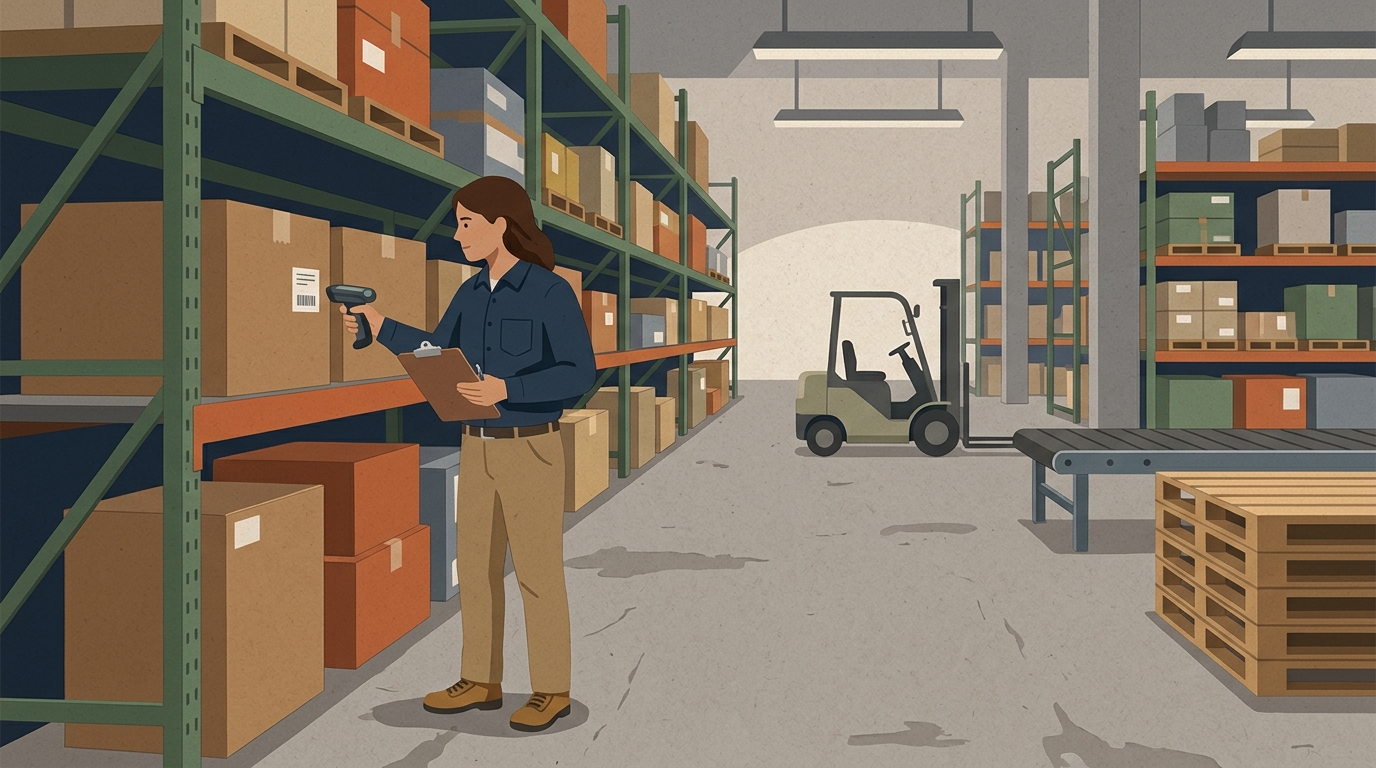
A Warehouse Associate interview is usually short and practical. Interviewers are testing three things: whether you can hold the physical pace, whether you record and scan work accurately, and whether you will turn up for the shift you agreed to. Expect a screening call, one on-site interview that often includes a walk through the warehouse, and in many cases a practical or physical assessment before an offer.
This guide is country-neutral. Occupational detail comes from the U.S. Department of Labor's O*NET OnLine profile for Laborers and Freight, Stock, and Material Movers, Hand, which describes the duties well in most countries — but hiring rules, background checks, licensing and pay structures vary by country, state or province, and employer, so treat the posting and your local regulator as your source of truth.
What the Warehouse Associate Interview Process Looks Like
This guide is country-neutral. Hiring practice differs: in some countries warehousing is dominated by staffing agencies and temp-to-permanent placements, in others by direct site hiring or union-agreed shift patterns. Drug testing, medical assessments and criminal record checks are permitted in some jurisdictions and restricted in others, so follow the employer's stated process.
The stages you will most often see:
1. Application and screening questions. Online or at a hiring event. Questions cover shift availability, repeated lifting and carrying, right to work, and any equipment certification such as a forklift or powered industrial truck licence.
2. Phone or text screen, 10 to 20 minutes. A recruiter, agency consultant or site HR coordinator confirms which shifts you can work — nights, weekends, four-on-four-off — your commute, and what equipment you can operate.
3. On-site interview. Usually a shift supervisor or operations lead, sometimes with HR. Twenty to forty minutes of situational questions on accuracy, safety and teamwork, often followed by a walk onto the floor. O*NET OnLine reports that 84% of workers in this occupation are exposed to contaminants every day and 80% wear common protective equipment such as safety shoes, glasses, gloves or hearing protection every day — the tour is partly a test of whether the noise, cold and dust put you off.
4. Practical or physical assessment. Common, not universal: a lift-and-carry demonstration, a scanner or pick simulation, a short numeracy and label-reading test, or a supervised evaluation on a pallet truck or reach truck.
5. Offer and pre-start checks. Volume hiring moves fast, so offers often arrive within days. Checks vary by jurisdiction and employer.
O*NET OnLine classifies this occupation as Job Zone 1-2, 'Very Little to Some Preparation Needed' — typically a high school diploma or equivalent plus a few days to a year of on-the-job training. So interviewers are not testing qualifications. Entry-level candidates should show evidence of attendance and following procedure anywhere; experienced candidates should quote throughput, accuracy and damage figures from their last site.
Common Interview Questions by Category
Questions cluster around the duties listed for the occupation. Prepare one example for each group.
Material handling and equipment - Which equipment have you used to move freight, stock or materials — pallet jack, powered pallet truck, forklift, order picker, conveyor? O*NET OnLine lists Industrial Truck and Tractor Operators and Conveyor Operators and Tenders as related occupations. - Have you attached slings, hooks or other devices to lift and guide a load? Who signalled? - How do you install bracing, padding or strapping so a load does not shift or get damaged in transit?
Accuracy, paperwork and systems - How do you read a work order, or take oral instructions, to work out what materials and equipment you need? - How do you record units handled or moved — daily production sheets, work tickets, RF scanner, warehouse management system? - Tell me about a time your count did not match the system. - What do you do with a label that is damaged or does not match the item?
Safety, PPE and site rules - Which protective equipment did you wear every shift, and who checked it? - Describe a near-miss you reported and what changed afterwards. - How do you work safely as a pedestrian around moving forklifts and live conveyors?
Pace, stamina and shift reliability - This role means handling objects almost continually — how does that compare with your last job? - Which shifts can you commit to, and how do you feel about overtime at peak? - What is your attendance record over the last year?
Teamwork and handover - How do you hand over to the next shift mid-task? - A colleague is lifting alone something that needs two people. What do you say?
Sample Questions and Strong Answers
Use these as structures, not scripts. If you are entry-level, use counts from a retail stockroom, delivery, farm, catering or military work rather than inventing warehouse figures.
How do you keep your counts accurate during a busy pick?
Strong answer
I scan every item rather than scanning one and keying a quantity, because that is where most of my errors used to come from. At a previous employer I recorded units moved on a daily production sheet as well as in the handheld, and reconciled the two before handover. If the scanner flagged a short pick I stopped and recounted the location rather than closing the task to protect my rate.
Describe how you secure a mixed pallet for transport.
Strong answer
Heaviest and most stable cartons on the bottom, nothing overhanging the pallet edge, voids filled so the stack cannot shift. Corner boards or padding on crushable goods, then strapping or wrap tensioned enough to hold the load to the pallet without crushing the bottom layer. Installing bracing, padding or strapping to prevent shifting or damage is a listed task for this occupation in the U.S. Department of Labor's O*NET OnLine profile, and at a previous site it was our biggest source of damage claims.
Tell me about a discrepancy between the system and the physical stock.
Strong answer
A location showed twelve cases and I found nine. I did not adjust it myself — I flagged it to the shift lead, checked adjacent locations and the recent putaway history, and found three cases slotted one bay over. We corrected the putaway rather than writing off stock.
How do you stay safe around forklifts and conveyors?
Strong answer
I stay in marked pedestrian walkways, make eye contact with the operator before crossing an aisle, and never walk under raised forks. I wear the site's required protective equipment every shift — O*NET OnLine reports 80% of workers in this occupation wear common protective equipment such as safety shoes, glasses, gloves or hearing protection every day. I never clear a conveyor jam while the belt is live; I isolate it and tell the next station.
The work is physical and repetitive. How do you handle that?
Strong answer
I pace myself rather than sprinting the first hour, use a pallet jack or a team lift instead of carrying awkward loads solo, keep the load close and pivot with my feet rather than twisting. O*NET OnLine reports 74% of workers in this occupation handle or control objects continually or almost continually, so grip fatigue is real — gloves that fit and short stretches at breaks keep my accuracy steady late in the shift.
What are your shift and overtime expectations?
Strong answer
I can commit to the night pattern in the posting, including the weekend rotation, and take overtime at peak with notice. O*NET OnLine reports 62% of workers in this occupation work more than 40 hours a week, so I would rather be straight about what I can sustain than agree to everything and then call in. My commute is 25 minutes by car with a bus route as backup.
How to Prepare Before the Interview
- Read the posting and list every piece of equipment, system and shift pattern it names — pallet jack, reach truck, RF scanner, WMS, conveyor, chilled or ambient, four-on-four-off. Mark which you have used and which you have only seen.
- Write down three numbers from recent work: units or cases handled per hour, your pick or count accuracy, and your attendance over the last six months. Entry-level candidates should substitute equivalent figures from stockroom, delivery or similar work.
- Put documents in one folder: photo ID, proof of right to work in the country you are applying in, any forklift or powered industrial truck certificate with its expiry date, manual handling or safety training records, and two references who can confirm timekeeping.
- Rehearse one safety story and one accuracy story aloud — what happened, what you did, what changed. Name the protective equipment you wore and who you reported to, since O*NET OnLine reports 84% of workers in this occupation are exposed to contaminants every day.
- Ask the recruiter directly whether there is a practical element — lift test, scanner demonstration, equipment evaluation, numeracy and label-reading check — and what footwear to arrive in.
- Time the commute for the actual shift start, including whether transport runs at 05:00 or on a Sunday.
- Confirm your equipment certification status with the issuing body or employer rather than guessing; rules on who may operate powered equipment, and whether a licence transfers between employers or countries, differ by jurisdiction and site.
Questions to Ask the Interviewer
- What are the productivity and accuracy targets for this role in the first 90 days, and how are they measured — cases per hour, cycle count variance?
- Which equipment would I be trained on, does the site run its own evaluation before letting someone on a reach truck or order picker, and is that training paid?
- How is work issued on the floor — paper work orders and work tickets, handheld scanner, voice pick — and how do associates record units moved at the end of a shift?
- How do shift teams hand over mid-task, and how many associates cover a zone on nights compared with days?
- What does peak look like here for overtime, and how much notice do associates get before extra shifts?
- What is the usual path from associate to equipment operator, team lead or inbound quality control at this site?
Frequently Asked Questions
What should I wear to a Warehouse Associate interview?
Clean, plain workwear or smart-casual clothes you could safely walk a warehouse floor in. Closed-toe, flat, sturdy shoes are the key item, because many interviews include a tour and some sites will not let you past the office in open shoes. Avoid loose jewellery and lanyards that could catch in equipment. If it is a hiring event at the site, assume you will be on the floor and bring your own safety footwear if you own some.
Is the lift or physical test timed, and can I decline it?
It varies by employer and jurisdiction. Where one is used it is usually a short demonstration — lifting a set weight to a set height a few times, or moving loaded cartons for a few minutes — rather than a race, though some sites do measure cases moved against a clock. Ask the recruiter what the assessment involves and what the weight limits are. Rules on what physical or medical testing an employer may require differ by country and state, so if you have a condition affecting lifting, ask the employer about their process.
I do not have a forklift licence. Will that rule me out?
Usually not. Many associate roles are hand-picking, packing and loading, and O*NET OnLine classifies the occupation as needing very little to some preparation, with on-the-job training from a few days to a year. Say clearly what you have operated — manual pallet jack, powered pallet truck, conveyor station — and ask whether the site funds equipment training. If a posting lists a licence as mandatory, check with the issuing body in your country whether your certificate counts and is still in date.
How do I explain gaps or short agency placements?
Warehousing hires heavily through agencies and seasonal peaks, so a run of short assignments is normal and interviewers know it. Name the assignment type — peak cover, contract ended — rather than leaving it blank. For a genuine gap, state the period, what you did, and that you are available for the full shift pattern now. Then move to attendance: a clean recent attendance record carries more weight than an unbroken employment line.
How is pay usually structured, and where do I check it?
Pay is typically hourly, often with shift premiums for nights and weekends, sometimes overtime rates after a set number of hours, and at some sites a productivity or attendance bonus. Agency placements may pay differently from direct-hire roles at the same site. Check current rates with your national labour or statistics agency, the relevant union or industry body, and the employer's posting — and ask whether the quoted rate includes shift premium.
Sources
- U.S. Department of Labor / O*NET OnLine — 53-7062.00 - Laborers and Freight, Stock, and Material Movers, Hand