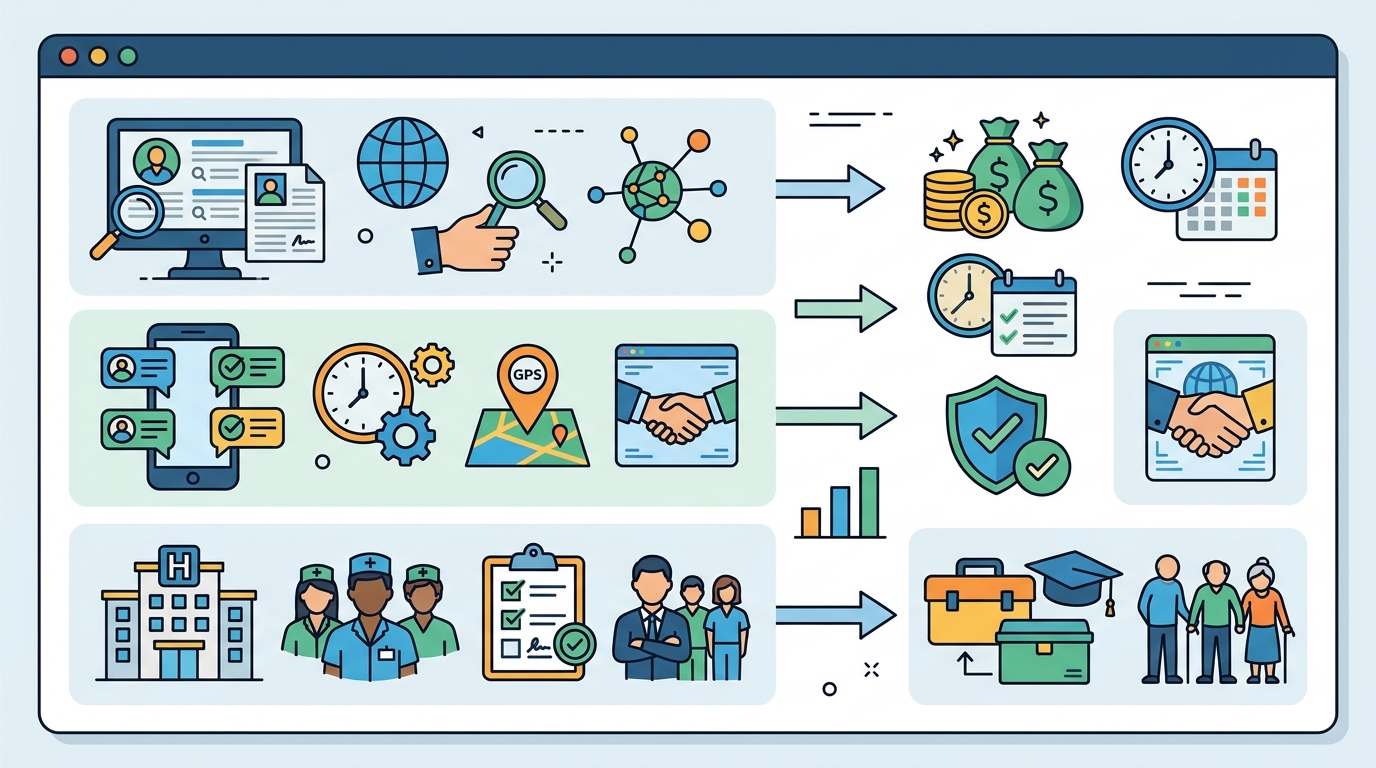
There is no single best platform for caregiver work — there are three routes that suit different people. Care marketplaces and job boards put you in front of families and employers quickly but leave you to negotiate pay; visit-based gig apps give you short jobs you accept on your phone; licensed agencies screen you hardest and take longest, but hand you scheduled clients and an employment relationship.
Most caregivers end up using more than one. Which you start with depends on how fast you need income, whether you hold a certification, and whether you want steady hours or flexible ones.
The Contenders
Care marketplaces. Profile-based sites where families post child care, elder care, special needs and overnight jobs, and caregivers apply directly. Care.com is the best-known. Its enrolment flow is: share what you're looking for, add background check info, build your profile, then start applying for jobs (Care.com, 2026-02-11). Every individual caregiver must complete a background check, which collects legal name, address, birth date and Social Security number (Care.com, 2026-02-11) and is renewed annually while you stay active (Care.com, undated) — caregivers pay an annual fee for that screening (Care.com Help Center, undated).
Visit-based gig apps. Short, individual visits rather than a long-term client. On the Papa Pal app, companion caregivers browse nearby visits and tap to accept the ones that work for them, and the app tracks their drive (Papa, undated). Papa partners with employers, Medicaid and Medicare Advantage plans to offer household and wellness services (third-party account, undated), so availability depends on which health plans operate near you. The work is companionship, errands and light household help, not hands-on clinical care.
General job boards. Boards such as Indeed aggregate vacancies from agencies, residential homes and hospices. Caregiver searches also surface openings tagged Nursing Assistant and Home Health Aide (Indeed, undated), so a single search term hides roles you qualify for. Your country's public employment service runs a free vacancy database too, often listing publicly funded providers that advertise nowhere else.
Agencies. Licensed home care and home health agencies hire you as their worker and assign clients. They screen hardest: agencies often must run fingerprint checks and registry searches, and those billing Medicare or Medicaid face additional background-check requirements (Discovered.ai, undated). They can also access records individuals cannot obtain on their own (1heart Caregiver Services, undated).
Side-by-Side Comparison
| Route | Speed to first job | Pay transparency | Vetting required | Part-time vs full-time |
|---|---|---|---|---|
| Care marketplace | Days to weeks — you apply once your profile and background check clear (Care.com, 2026-02-11) | You agree the rate with the family; jobs pay outside the platform, by whatever method suits both of you (Care.com Help Center, undated) | Background check with ID details on all individual caregivers, renewed annually (Care.com, undated) | Both — families post anything from after-school hours to live-in elder care |
| Visit-based gig app | Fast — ID, plus car insurance if you'll drive clients, then a background check, then you book a first visit (Papa, undated) | Visit terms shown before you accept; hourly wages paid the next day after a visit (third-party account, undated) | Lightest: a driver's licence, state ID or passport, plus the app's own check (Papa, undated) | Part-time by design — visits can be booked up to two weeks ahead or last minute, with no long-term commitments (Papa, undated) |
| General job board | Slow per application, high volume; look under Nursing Assistant and Home Health Aide too (Indeed, undated) | Varies by posting — some state an hourly band, many state nothing | Set by the employer: often certification plus a background check | Both; shift patterns and live-in terms are in the posting |
| Agency | Weeks — fingerprinting and registry searches take time (Discovered.ai, undated) | Stated at offer, usually an hourly rate with set shift types | Heaviest, and agencies can pull records you cannot (1heart Caregiver Services, undated) | Best route to full-time hours; also weekend and overnight part-time shifts |
Two mechanics matter before you apply. On marketplaces, applying is a one-click message to the family — fast, but when a family hires you, the family pays you directly and in most cases you become their household employee (Care.com Help Center, undated), so check your local tax and registration rules. On job boards, some caregiver listings use quick-apply with your stored profile, while agency and hospital listings redirect to the employer's own system, which will want full work history and uploaded certificates.
Which to Use Depending on Your Situation
I'm new to care work with no certification
Start on a visit-based gig app or with companionship listings on a marketplace. A Papa Pal application needs an ID and, for transportation visits, a copy of your car insurance (Papa, undated) — no clinical credential. Build references there, then move to agency work.
I need money within two weeks
Run a gig app alongside marketplace applications. Gig visits can be accepted at the last minute and hourly wages are paid the next day after a visit (third-party account, undated), which beats waiting out an agency's fingerprint and registry checks (Discovered.ai, undated).
I want one steady employer and guaranteed hours
Go agency-first, and on job boards save searches for Nursing Assistant and Home Health Aide as well as caregiver (Indeed, undated). Check your public employment service's vacancy database too — publicly funded providers often post only there.
I have a gap in my work history
Marketplaces and gig apps judge you mainly on the background check result and your profile, not on continuous employment. A marketplace profile lets you lead with the care you've given, including unpaid family caregiving, which many families weigh over an unbroken CV.
I have something on my record
Agencies billing Medicare or Medicaid face extra background-check requirements and registry searches (Discovered.ai, undated), and families are advised to ask an agency how often it checks and to review the results (Caring Village, undated). Private-pay agencies and marketplace families set their own thresholds, so apply where screening is a single criminal check rather than a fingerprint-and-registry package — and never pay anyone promising to clear or bypass a check.
Getting Started on Your Best-Fit Platform
Most readers will start on a care marketplace, because it is the fastest paid route that does not require a certification.
- Gather documents first. Government-issued ID, any certification PDFs, and two contactable references. Home health aide roles may require specific certifications such as Basic Life Support, with CNA experience in a home setting valued (Vivian Health, undated).
- Complete the background check before anything else. All individual caregivers must complete one to join Care.com (Care.com, 2026-02-11), and you pay an annual fee because it is renewed each year (Care.com Help Center, undated). A screening fee is normal; a fee to be placed with clients is not — walk away from that.
- Build a specific profile. Name the care you actually do — infant, dementia, mobility, overnight, post-surgical — plus licence status, whether you drive clients, languages and a weekly availability grid. Families filter by care type and schedule, not by adjectives.
- Set your rate before you apply. Marketplace jobs pay outside the platform, using whatever method suits caregiver and family (Care.com Help Center, undated), so have one figure ready for regular weekly hours and another for one-off overnight or holiday cover.
- Apply, then keep a second channel open. Marketplace applications are one-click messages — send ten before judging the channel. On job boards, check whether the button submits in-platform or redirects to an agency's careers system. Use Care.com's CareProtect safety tools if something goes wrong: always-on monitoring that flags fraud and removes rule-breaking users, a 24/7 safety hotline and a safety centre (Care.com, 2026-02-11). Meanwhile keep a gig app or agency application running.
Frequently Asked Questions
Do I need a certification to start, or can I skip it?
You can start without one on gig apps and marketplaces — a Papa Pal application needs an ID and, for transportation visits, car insurance, followed by the platform's background check (Papa, undated). Agencies differ: home health aide roles may require background checks and certifications such as Basic Life Support (Vivian Health, undated). A CHHA certification is commonly offered as an add-on after a CNA program (CNEI, undated), and some colleges run a 10-week program covering what's needed for state certification and employment as a Nursing Assistant or Home Health Aide in long-term care (LASC, undated).
Who employs me — the platform, the family, or the agency?
An agency employs you and assigns your clients. On a marketplace it is the reverse: when a family hires a caregiver found on Care.com, the family pays the caregiver directly and in most cases the caregiver becomes the family's household employee (Care.com Help Center, undated). Gig apps sit between, with visits accepted in-app and hourly wages paid the next day (third-party account, undated). Tax and registration rules differ by country and, in some countries, by state or province — check with your local tax authority before your first shift.
Is it normal to be charged anything to join?
A renewable screening fee is — Care.com charges caregivers an annual fee because the check is renewed yearly (Care.com Help Center, undated), and it notes a discount for military spouses, available by contacting customer support before completing enrolment (Care.com, 2026-02-11). Agencies should never charge you: they run screening as part of hiring and can access records you cannot obtain yourself (1heart Caregiver Services, undated). Anyone charging for a placement, a client list or board priority is a red flag.
Sources
- Care.com — Find caregiver jobs you'll love with Care.com (2026-02-11)
- Care.com Help Center — Why does Care.com charge caregivers a background screening fee?